RFID jewelry tags help jewelry stores, wholesalers, showrooms, and brand owners count high-value items faster than manual barcode checks. The tag itself is only one part of the project. A useful jewelry RFID setup also needs the right frequency, tag shape, reader workflow, encoded data, display-tray placement, and staff process.
For most buyers, the best starting point is not a single read-range number. Start with the inventory scenario: counter tray checks, safe-room stock counts, exhibition movement, warehouse receiving, or store-to-store transfer. Then test RFID jewelry tag samples on real rings, necklaces, watches, bracelets, sunglasses, or accessories before approving bulk production.
Quick Recommendation
Choose RFID jewelry tags when each item needs a digital identity that can support faster counting, stock lookup, and loss-control workflows. Use HF jewelry tags when close-range, controlled reading is preferred. Use UHF jewelry tags when the project needs faster multi-tag reading across a tray or counter, provided the reader environment is tested carefully.
| Project Question | What To Check | Why It Matters |
|---|---|---|
| How will inventory be counted? | Tray scan, counter scan, handheld scan, cabinet scan, or receiving check | The scan workflow affects frequency, reader power, antenna position, and tag orientation. |
| Which products will be tagged? | Rings, necklaces, earrings, bracelets, watches, sunglasses, or accessories | Small, curved, metallic, or densely packed items can change read performance. |
| Should the tag be HF or UHF? | 13.56 MHz close-range use or 860-960 MHz multi-tag reading | Frequency should match the reader system and inventory process, not only the tag price. |
| What data needs to be encoded? | UID-only use, SKU, serial number, item ID, location, or database mapping | Encoding and printed numbering should be planned together before production. |
| Will the tag affect presentation? | Loop length, tag size, color, attachment method, and visual position | Jewelry tags must be readable while still looking acceptable in display trays. |
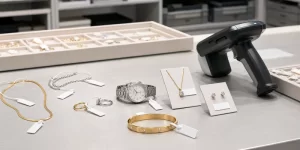
An RFID jewelry tag is a small RFID tag designed to be attached to individual jewelry or accessory items. ASIARFID describes jewelry tags as a product family used for jewelry management, inventory management, supply-chain management, sales data analysis, and safety management. The same category can also apply to watches, sunglasses, and other small accessories where item-level identification is needed.
ASIARFID lists both HF Jewelry Tag and UHF Tag Jewelry options. The right choice depends on the reader system and the way staff will count items. A display tray with many rings close together creates a different RF environment from a single item held near a desktop reader.
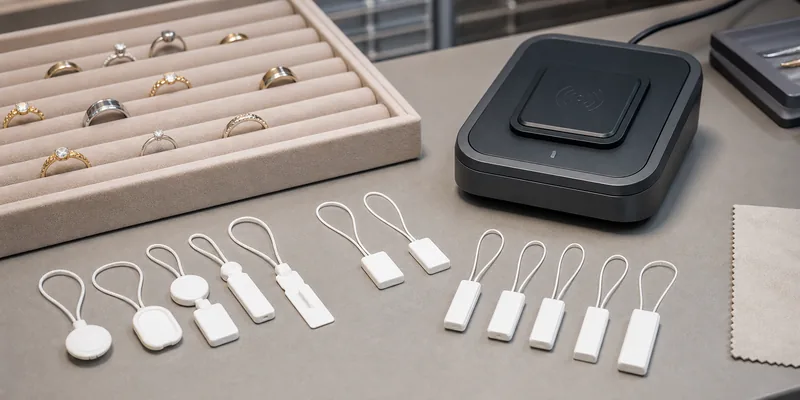
HF jewelry tags commonly operate at 13.56 MHz and are often chosen for short, controlled reads. ASIARFID’s HF jewelry tag page describes 13.56 MHz operation and close-range jewelry identification. This can fit projects where staff checks one tray, one item, or a compact reader area at a time.
UHF jewelry tags operate in the 860-960 MHz range and are commonly considered when buyers want faster multi-tag counting. ASIARFID’s UHF jewelry tag page describes UHF jewelry tags for retail, wholesale, storage, inventory management, logistics management, supply-chain management, and electronic security. In practice, UHF read performance depends on reader power, antenna design, tag orientation, jewelry material, item spacing, nearby metal, display trays, and interference.
Do not choose HF or UHF from the frequency name alone. Choose from the operating workflow backward: how many items are counted at once, how close the reader will be, how often staff scans, where the tags sit, and how the inventory software matches each encoded value to a product record.
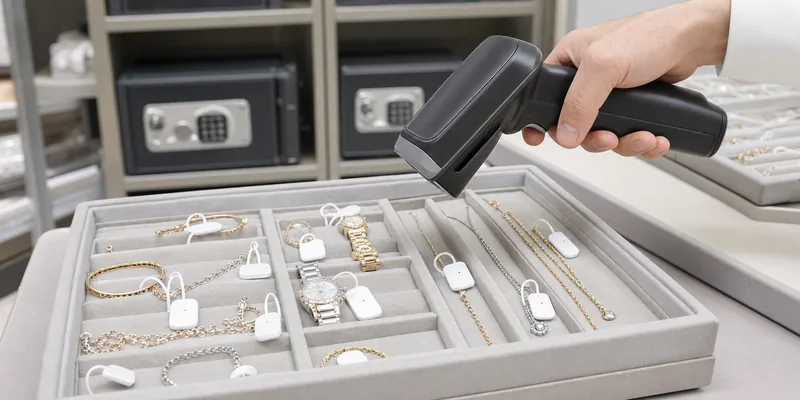
A tag that reads cleanly on a desk may behave differently once it is looped around a ring, attached to a chain, placed beside metal watch cases, or stacked inside a velvet tray. Test samples with the actual jewelry types, tray material, scan distance, reader model, and staff workflow. If the store uses safes, glass counters, metal drawers, or dense trays, include those conditions in the test.
2. Match the tag shape to display and handling
Jewelry tags need to stay attached without damaging the item or making the display look untidy. Confirm tag body size, loop material, loop length, hole position, color, and whether the tag will be removed at sale. A small tag may look better, but antenna size and placement can affect reading. A slightly larger tag may be easier to scan consistently in a busy stocktake.
3. Plan encoded data before printing
Each tag may carry a chip UID, a written item ID, or an encoded value mapped to the inventory database. Visible numbering, barcode, SKU, or item description should match the software plan. If the printed number and encoded data do not align, staff may still need manual cleanup after the tags arrive.
4. Decide where RFID fits with existing controls
RFID jewelry tags can support faster inventory checks, item lookup, and exception review, but they should not be treated as a complete security system by themselves. The store may still need staff procedures, display rules, camera coverage, locked trays, alarm policies, and POS reconciliation. RFID is most useful when the physical tag, reader setup, and inventory software are planned together.
Common Applications
Retail store stocktaking: Staff can scan tagged trays or counters during opening, closing, or shift changes. The goal is faster exception checking, not blind trust in one scan.
Wholesale and showroom management: Buyers handling many samples can use RFID item IDs to track movement between display areas, storage, and customer appointments.
Warehouse receiving and transfer: RFID jewelry tags can support receiving checks, internal transfer, and SKU verification when encoded data is matched to the inventory system.
Exhibition and pop-up events: Temporary displays need clear rules for scanning, item handover, and return checks. Tag attachment and reader setup should be tested before the event, not at the booth.
What To Prepare Before Ordering
- Jewelry or accessory types, including photos and typical tray layouts.
- Preferred scan workflow: handheld reader, desktop reader, tray scan, cabinet scan, or receiving station.
- Frequency requirement if your system provider has already specified HF or UHF.
- Tag size, loop length, color, printed information, numbering rules, and attachment method.
- Encoding plan: UID-only, item ID, SKU, serial sequence, or database import file.
- Sample-test conditions: reader model, antenna position, item density, safe/counter material, and scan distance.
- Packaging and sorting rules if tags must arrive grouped by SKU, branch, tray, or item sequence.
Why Work With ASIARFID
ASIARFID supplies RFID jewelry tags as part of a wider RFID tags range that also includes RFID stickers, inlays, anti-metal tags, laundry tags, library tags, clothing tags, and other custom tag formats. For jewelry projects, the useful discussion starts with the reader environment, item type, tag attachment, printed data, encoding file, and sample test plan.
If your project is still early, send representative jewelry photos, tray layout, reader information, and data requirements. ASIARFID can help compare HF jewelry tags, UHF jewelry tags, RFID stickers, or custom RFID tag formats before production.
FAQ
RFID jewelry tags are useful when the store needs faster item counting or non-line-of-sight identification. Barcode labels can still be useful for visual checkout, printed SKU information, and low-cost manual scanning. Many projects use printed codes and RFID together.
Choose HF when the project needs close, controlled reading. Consider UHF when the goal is faster multi-tag inventory across trays or counters. The final choice should be tested with the actual reader, jewelry materials, tray density, and software workflow.
Jewelry metal, tag orientation, nearby items, and tray materials can all affect RFID performance. Test samples on real rings, necklaces, watches, and bracelets instead of assuming a loose-tag read result will match the display environment.
Can each jewelry tag have a printed number and encoded ID?
Yes, this is often possible when the numbering file and encoding file are prepared correctly. Confirm the visible number, encoded value, SKU, and database mapping before mass production.
They can support exception checks, movement tracking, and faster inventory review, but they are not a complete anti-theft system by themselves. Pair the tags with reader placement, staff rules, locked displays, POS reconciliation, and security procedures.
What should I send before requesting samples?
Send jewelry photos, product categories, tray layout, reader or software requirements, preferred HF or UHF direction, tag size target, printed information, encoding rules, and the stocktake workflow you want to test.
Conclusion
The right RFID jewelry tag is chosen from the inventory workflow backward. Define what staff need to scan, how many items are counted at once, which reader system is fixed, what data must be encoded, and how the tag will sit on each item. Then test HF and UHF jewelry tag samples in the real tray, counter, or storage layout before bulk production.