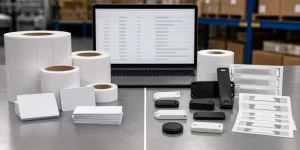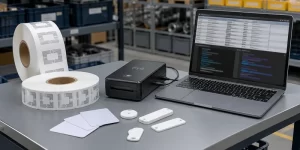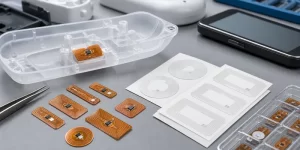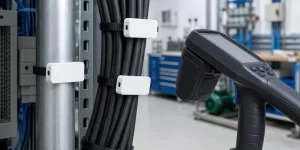
RFID clothing tags help apparel teams identify individual garments faster than manual barcode scanning. For a brand, factory, warehouse, or retailer, the real question is not simply whether RFID works. The question is which tag format, chip, attachment method, and encoding plan will still work when the garment is folded, packed, hung, shipped, counted, returned, or sold.
Most garment inventory projects use passive UHF RFID because it can support item-level counting across cartons, racks, and stockroom shelves. Actual read performance depends on reader power, antenna layout, tag orientation, garment material, packing density, and the way the tag is attached. A sample test is not optional if the project involves dense cartons, metal fixtures, liquid products nearby, or mixed garment materials.

Quick Recommendation
If the tag will be removed at checkout, start with an RFID hang tag or adhesive label. If the tag must stay with the garment for rental, uniform management, or after-sales service, discuss a sewn label or embedded option. If garments are packed tightly, ask for samples and test them in the actual carton, rack, or shelf position instead of testing one tag in open air.
| Buyer Decision | Better Starting Point | What To Confirm |
|---|---|---|
| Retail price ticketing | RFID hang tag or label | Artwork, barcode coexistence, EPC encoding, removal process |
| Factory WIP tracking | Durable RFID clothing label | Attachment method, sewing position, heat/press exposure |
| Stockroom cycle counts | UHF RFID garment tag | Reader/antenna layout, packing density, read zone design |
| Rental or uniform tracking | Sewn or embedded tag | Wash exposure, garment lifecycle, customer comfort |
| High-value apparel | RFID plus visible ID or NFC option | Authentication flow, privacy handling, customer-facing message |
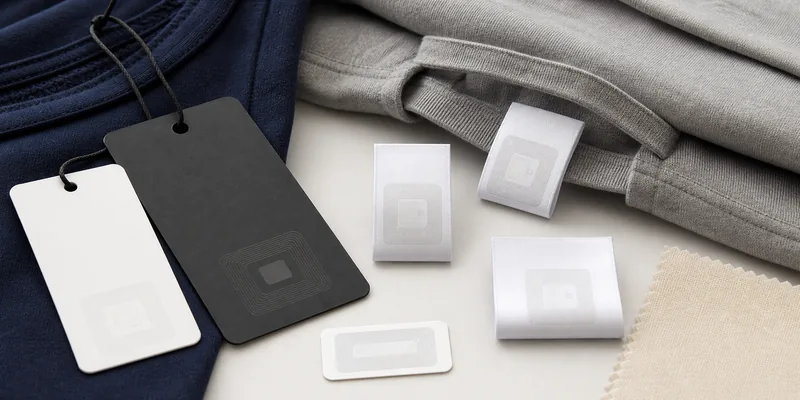
RFID clothing tags are RFID-enabled labels, hang tags, woven labels, stickers, or embedded tags used to identify garments at item level. In apparel inventory, each tag usually carries a unique electronic identifier that can be associated with SKU, size, color, batch, store location, or order data in the buyer’s software system.
The tag itself does not solve the inventory problem alone. It needs a reader, antenna setup, encoding method, software database, and a workflow for applying and checking tags. For apparel teams, this usually means coordinating the tag supplier, garment factory, printer, warehouse team, store operations team, and system integrator before bulk rollout.
In a typical UHF RFID garment workflow, tags are encoded with unique IDs before or during production. The garments are then scanned at receiving, packing, warehouse storage, store transfer, shelf count, checkout, return, or stock audit points. Instead of aiming a scanner at every barcode, staff can count multiple tagged garments in a controlled read zone.
That does not mean every garment will read correctly in every position. RF signals can be affected by tag orientation, garment stacking, foil packaging, liquids, dense cartons, metal shelving, and other nearby tags. A tag that reads well on a single shirt lying flat may behave differently when 80 garments are packed in a carton or when the tag is folded behind a thick fabric layer.
For this reason, sample validation should copy the real workflow. Test hanging garments, folded garments, carton-packed garments, returns, and any anti-theft or checkout process that will touch the tag.
How To Choose The Right RFID Clothing Tag
Start With The Attachment Method
Attachment decides more than appearance. It affects read angle, durability, production speed, removal, privacy, and cost. A hang tag is easy to add to existing garment ticketing, but it may be removed after sale. A sewn label can stay with a garment, but it needs comfort, washing, and sewing-position checks. An adhesive RFID label may fit packaging or carton workflows, but it may not be the best choice for fabrics that flex, wrinkle, or shed fibers.
If your project already uses a paper swing ticket, an RFID hang tag may be the lowest-friction test format. If the garment needs lifecycle tracking after sale or after rental return, ask ASIARFID about a clothing label format that matches the fabric, washing exposure, and user comfort requirement.
Match Frequency And Chip To The Workflow
For garment inventory, UHF RFID is commonly selected when the goal is faster stock counts and longer read zones. HF or NFC may be useful when the buyer wants short-range phone interaction, authentication, care content, or customer engagement. Do not choose the chip only from a catalogue name. Confirm protocol, memory, encoding format, reader compatibility, and any retailer or marketplace data requirements.
If a retail program requires EPC-style serialization or a specific data structure, define that requirement before ordering tags. Re-encoding after tags are attached to garments can be costly and slow.
Keep Barcode And Human-Readable Labels Where Needed
RFID does not automatically replace visible garment information. Many apparel workflows still need barcode, SKU, size, color, price, care label, or return information. The practical approach is often a hybrid label: visible data for staff and customers, RFID data for fast system reads.
Ask whether the same ticket needs printing, encoding, numbering, or quality inspection. A good sample approval should include both the physical label and the encoded data, not only the artwork.
Common Applications
RFID clothing tags are used across apparel production and retail operations:
- Garment factory work-in-process tracking, where batches move through cutting, sewing, finishing, packing, and shipping.
- Warehouse receiving and dispatch, where teams need faster carton or rack verification.
- Retail stockroom and sales-floor cycle counts, where size and color availability affect sales.
- Omnichannel fulfillment, where store inventory accuracy affects click-and-collect and ship-from-store promises.
- Rental garments, uniforms, and costumes, where the tag may need to survive repeated use and cleaning.
- High-value apparel authentication, where NFC or serialized RFID can support product verification when paired with the right software flow.
The best tag choice changes by application. A disposable retail hang tag and a long-life uniform tag should not be specified the same way.
What To Prepare Before Ordering Samples
Before asking for a quote, prepare the operating details that affect tag design and testing:
- Garment type, material, thickness, and whether the tag will be flat, folded, sewn, tied, or attached to packaging.
- Expected scan points: factory line, carton packing, warehouse gate, handheld reader, store shelf, checkout, or returns desk.
- Reader type, antenna layout, and software or EPC encoding requirements if already known.
- Artwork, size, color, barcode, numbering, and any human-readable fields.
- Whether tags are removed at sale, kept for warranty, or used through rental/washing cycles.
- Carton quantity, stacking method, metal shelving, liquid products nearby, and other conditions that could affect reads.
- Privacy or customer communication requirements if the tag remains on the garment after purchase.
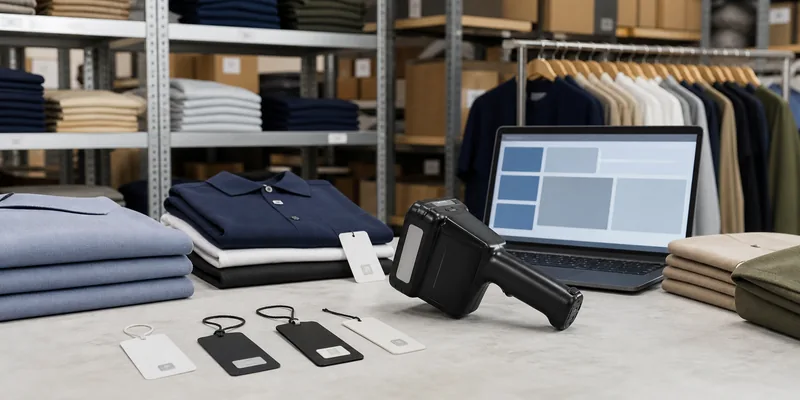
Buyer Mistakes To Avoid
One common mistake is testing a tag in a clean office and assuming the result applies to a packed warehouse. Another is choosing the smallest or cheapest inlay before confirming the needed read zone. Small tags can be useful, but antenna size and placement affect performance.
A third mistake is treating encoding as an afterthought. For apparel, unique IDs must match the buyer’s data model. If SKU, color, size, serial number, and store system mapping are unclear, the physical tag may be correct but the deployment can still fail.
Finally, do not assume every RFID clothing tag is washable or suitable for long-term garment use. If the tag must pass laundry, heat press, ironing, dry cleaning, or repeated wear, ask for the matching product construction and test conditions before approving bulk production.
Why Work With ASIARFID
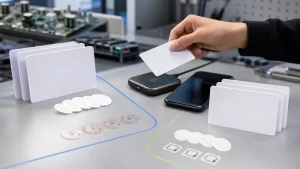
ASIARFID supplies RFID tags, RFID clothing tags, RFID inlays, stickers, anti-metal tags, cards, and wristbands for B2B projects. For apparel buyers, the useful starting point is a clear requirements review: garment type, attachment method, chip/frequency, artwork, encoding, read environment, and sample test plan.
Explore ASIARFID’s RFID clothing tags for garment-specific options, compare broader custom RFID tags, or review RFID inlay choices if your project needs a custom label construction. For packaging or carton-level use, RFID stickers may also be relevant. If garments are stored near metal fixtures or tagged accessories, review anti-metal RFID tags before deciding the test setup.
Send your garment type, tag position, reader environment, artwork, quantity, and encoding requirements to request samples or a project recommendation.
FAQ
Not always. RFID clothing tags can include hang tags, woven labels, adhesive labels, or other garment-facing formats. RFID laundry tags are usually designed for repeated washing and textile rental workflows. If washing or heat exposure matters, specify that condition before ordering samples.
Which RFID frequency is best for apparel inventory?
Many garment inventory projects use UHF RFID because it supports faster counting across racks, cartons, and stockroom shelves. HF or NFC may fit short-range authentication or phone interaction. The right choice depends on reader setup, scan distance, data needs, and whether the tag is customer-facing.
Often, yes, but the exact printing and encoding workflow should be confirmed before production. Provide artwork, barcode format, numbering rules, and encoding data so the supplier can check whether the tag structure supports both visible printing and RFID data.
Read distance varies with reader power, antenna, tag size, orientation, garment material, packing density, and interference. Do not approve a tag from a single open-air read test. Test the sample in the same carton, rack, shelf, or checkout environment where it will be used.
They can, depending on the tag format and project goal, but privacy, comfort, care-label, and customer communication requirements should be reviewed. For customer-facing interaction, NFC may be useful. For long-term garment tracking, durability and attachment method become more important.
What information should I send for a quotation?
Send the garment type, intended tag position, quantity, artwork, size, frequency or chip preference, encoding rules, reader environment, and sample test scenario. If any requirement is unknown, describe the workflow and ask for a recommended sample set.
Conclusion
The right RFID clothing tag is chosen from the garment workflow, not from a generic tag list. Start with how the garment will be tagged, scanned, packed, sold, returned, or reused. Then confirm frequency, chip, label construction, printing, encoding, and sample testing under real operating conditions.
For apparel inventory projects, ASIARFID can help compare garment tag formats and prepare samples for practical read testing before bulk ordering.