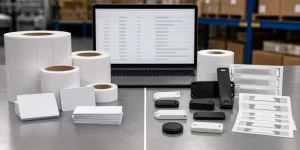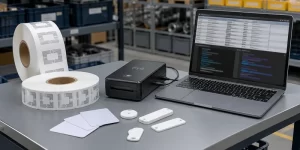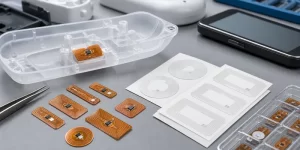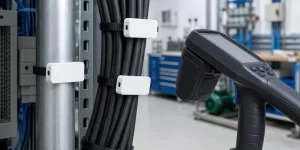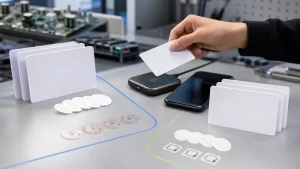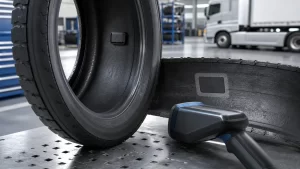
Custom RFID tags are worth considering when a standard RFID label, card, inlay, or hard tag cannot match the asset surface, read workflow, environment, artwork, or encoding plan. Stock RFID tags are still the better starting point when the project is simple, urgent, low-risk, or easy to test with an existing tag format.
The buying decision should not start with the catalog photo. It should start with the item being tagged, the reader setup, the mounting surface, the expected service life, and the data that must connect to the buyer’s system. A stock tag can be right for cartons and plastic bins. A custom RFID tag may be safer for metal equipment, branded NFC campaigns, compact products, harsh handling, or printed and encoded tag sets.
Quick Recommendation
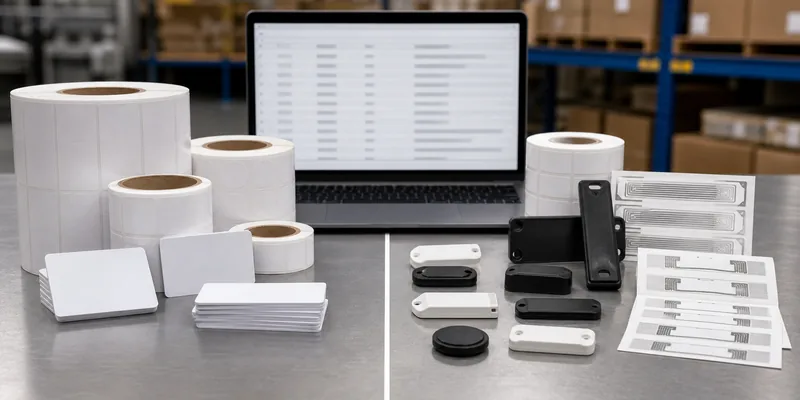
Use stock RFID tags when the object is flat, non-metal, easy to label, and compatible with a known reader setup. Move toward custom RFID tags when the tag must fit a special size, survive a difficult environment, attach to metal or curved surfaces, carry branded printing, match a data file, or pass a sample test that standard tags cannot meet.
| Buyer Situation | Better Starting Point | What To Check First |
|---|---|---|
| Cartons, folders, plastic bins, simple assets | Stock RFID labels or stickers | Reader frequency, label size, adhesive, and encoding format |
| Metal tools, cabinets, racks, equipment housings | Anti-metal or custom RFID tags | Mounting surface, tag orientation, read distance, and fixing method |
| Brand campaign, membership, event, or customer touchpoint | Custom printed RFID/NFC tag, card, or wristband | Artwork, chip, QR backup, encoding, and user interaction |
| Special shape, limited space, harsh handling | Custom form factor or sample set | Dimensions, material, antenna space, durability, and test plan |
Stock RFID tags are ready-made RFID products with fixed dimensions, materials, chip options, antenna design, and packaging. They may include adhesive labels, wet inlays, hard tags, access cards, wristbands, key fobs, or other common forms. Buyers often choose them because they are easier to sample, compare, and reorder.
A stock tag works best when the use case fits a known pattern: carton labels, short-term item labels, simple document tracking, close-range access credentials, or NFC stickers on non-metal surfaces. ASIARFID’s RFID stickers page describes adhesive RFID stickers as a structure with a surface layer, RFID inlay, adhesive layer, and bottom layer.
Custom RFID tags are built or configured around a project requirement. Customization may involve chip and frequency, tag size, antenna design, enclosure material, adhesive, mounting hole, color, logo, QR code, serial number, laser code, roll format, packaging, or pre-encoding. ASIARFID’s RFID tags category includes multiple tag families and states that tags can be customized according to buyer needs.
Custom does not always mean a fully new engineered product. In many orders, customization means adapting a proven tag family: changing size, material, printing, numbering, encoding, backing, packing sequence, or chip option. That middle ground is often practical for B2B buyers.
Start with the surface
The surface often decides the tag family. Paper cartons, plastic bins, file folders, and glass are usually easier than metal, liquid-filled packaging, rubber handles, curved cylinders, and equipment with dense electronics nearby. If the tag sits directly on metal, compare anti-metal RFID tags or request samples with a spacer-backed structure instead of forcing a standard label into the wrong place.
Check the available space
Small spaces create tradeoffs. A smaller tag is easier to hide or mount, but antenna size and tag orientation still affect performance. If the item has only a narrow slot, screw hole, cable channel, curved pipe, or product recess, a custom or semi-custom tag may save time during installation.
Match customization to the workflow
A custom RFID tag should solve a real workflow problem. For a warehouse label, that may mean roll format, printer compatibility, EPC encoding, and barcode printing. For a branded NFC campaign, it may mean card material, clear artwork, a QR backup, and URL testing. For an industrial asset, it may mean anti-metal structure, mechanical fixing, abrasion resistance, and sample reads on the real equipment.
Plan printing and encoding together
Visible print and chip data should be planned as one job. ASIARFID’s RFID product process page lists coding and craft options such as laser engraving, spray code, barcode, QR code, serial number, adhesive backing, anti-metal construction, epoxy finish, and logo printing. If the printed serial number must match the encoded data, prepare the artwork proof and data file before production.
Common Buyer Mistakes
The first mistake is testing a tag in an easy environment and deploying it in a hard one. A sample that reads on a clean desk may fail on a metal rack, a wet container, a tightly packed carton, or a curved housing. The second mistake is treating custom RFID tags as a design choice only. Customization should improve fit, durability, read behavior, production handling, or data control.
The third mistake is ordering bulk quantities before a realistic sample test. A sample test should include the actual reader, antenna position, asset surface, tag placement, scan distance, orientation, staff handling, and nearby interference.
What To Prepare Before Requesting Samples
- Application: inventory, asset tracking, access, event, laundry, packaging, NFC interaction, or industrial tracking.
- Tagged item photos, material, surface shape, available space, and mounting position.
- Reader frequency, reader model, antenna setup, software requirement, and encoding format if known.
- Target tag format: label, inlay, hard tag, card, wristband, key fob, anti-metal tag, or small tag.
- Artwork needs: logo, color, barcode, QR code, serial number, UID marking, or blank supply.
- Environment: indoor, outdoor, heat, cold, moisture, cleaning, impact, abrasion, metal, or liquids.
- Quantity estimate, packing sequence, roll direction, printer/encoder requirement, and sample-test plan.
Where ASIARFID Fits
ASIARFID can help buyers compare custom RFID tags, RFID inlays, RFID stickers, anti-metal tags, cards, key fobs, and wristbands before bulk production. The useful inquiry is specific: send the object, surface, reader, data requirement, artwork, and environment so the sample recommendation can be based on the real project.
If the project is straightforward, stock tags may be enough. If the project has unusual size, material, read-zone, mounting, branding, or encoding requirements, ask for custom RFID tag samples and test them before the final order.
FAQ
No. Stock RFID tags are often better for standard labels, simple asset tracking, quick pilots, and low-risk deployments. Custom RFID tags are better when the project has specific physical, RF, printing, encoding, or environmental requirements.
Can stock RFID labels be used on metal?
Standard labels are usually not the first choice for direct metal mounting. Metal can reduce or block reads, so buyers should test anti-metal RFID tags or spacer-backed options on the real asset.
What can be customized on an RFID tag?
Common options include size, material, adhesive, chip, frequency, antenna format, logo, color, barcode, QR code, serial number, laser code, encoding, roll format, and packaging. Final options depend on the selected tag family.
Yes. Samples help confirm read performance, mounting, printing, encoding, durability, and handling before the buyer commits to bulk production.
They often do. Prepare artwork, visible numbering rules, barcode or QR values, encoded data, chip requirements, and packing sequence in one controlled file set.
Which RFID frequency should I choose?
Choose the frequency supported by the reader and application. LF, HF/NFC, and UHF RFID are not interchangeable, so confirm reader compatibility and software requirements before approving the tag.
Final Buying Advice
Stock RFID tags are the practical first test when the item, reader, surface, and workflow are ordinary. Custom RFID tags become valuable when the standard option creates installation, read, durability, branding, or data problems. Before ordering, define the application, test real samples, and keep the physical tag design, visible print, and encoded data aligned.