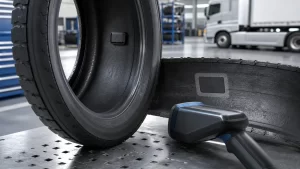
RFID tire tags are useful when a tire needs a stable digital identity from production to warehouse handling, fleet service, inspection, retreading, or recycling. The hard part is not deciding whether RFID can help. It is choosing a tag format that matches when the tag will be installed and how the tire will be used.
For most projects, the first choice is between embedded RFID tire tags and patch or inner-liner RFID tire tags. Embedded tags are usually considered when the tire maker wants the identifier to become part of the tire during production. Patch-style tags are usually considered when the tire already exists and the buyer needs tracking for fleets, dealers, maintenance teams, retreaders, or a pilot project.
Because tire environments involve rubber, curvature, heat, pressure, adhesive preparation, and repeated movement, buyers should treat RFID tire tracking as a tested application, not a simple label purchase. The RAIN Alliance describes RAIN as passive UHF RFID using the ISO/IEC 18000-63 air-interface protocol, also known as GS1 UHF Gen2. In tire projects, that standards language matters because the tag, reader, encoding format, and software workflow all need to agree.
Quick Recommendation
| Use Case | Better Starting Point | Why |
|---|---|---|
| Tire manufacturing traceability | Embedded RFID tire tag | The identifier can travel with the tire from production onward. |
| Fleet maintenance or aftermarket tracking | Patch RFID tire tag | The tire already exists, so installation flexibility matters. |
| Small pilot before system rollout | Patch RFID tire tag | Teams can test reader setup, software, and installation SOP before changing production. |
| Full lifecycle tire identity | Embedded or highly durable tire-specific tag | The tag must survive the intended lifecycle and remain associated with one tire. |
What Is an Embedded RFID Tire Tag?
An embedded RFID tire tag is designed to be integrated with the tire, usually for long-term identification. This approach fits tire manufacturers and large programs where the tag ID should be linked to production data, batch information, inspection records, warranty workflows, distribution, and end-of-life traceability.
The advantage is continuity. Once the tag is correctly paired with the tire record, the tire can be identified without relying only on visible markings or barcodes. The tradeoff is planning. The tag design, placement, production process, rubber compatibility, reader environment, and data standard should be validated before the tag becomes part of production.
What Is a Patch RFID Tire Tag?
A patch RFID tire tag is applied to a tire after the tire is made, commonly on the inner liner or another prepared tire surface depending on the product design. It is practical for fleet operators, tire dealers, warehouses, repair teams, retreaders, rental fleets, and RFID integrators that need a controllable rollout without redesigning the tire manufacturing process.
Patch tags are easier to pilot, but installation quality becomes critical. The surface may need cleaning, polishing or roughening, proper adhesive, curing time, and a clear inspection step. If the installation method is weak, the RFID system may be blamed for a problem that is actually caused by poor surface preparation.
Why Tire RFID Is Different From Ordinary Asset Tagging
A tire is not a flat carton or a plastic ID card. It bends, heats, cools, picks up dust and moisture, and may pass through harsh handling. Reader performance also changes with tag orientation, tire position, rubber structure, reader power, antenna design, and nearby vehicles or racks.
This is why buyers should avoid generic read-range promises. A short controlled read range may be enough for a handheld service check. A warehouse gate or conveyor workflow may need a different tag and reader setup. The correct question is not “How far can the tag read?” It is “Will this tag read reliably in my real tire workflow?”
What To Check Before Ordering RFID Tire Tags
- Installation timing: Is the tag installed during tire production, in a warehouse, at a dealer, or during fleet maintenance?
- Frequency and protocol: Confirm UHF RFID requirements, reader compatibility, regional regulations, and EPC/encoding format.
- Tag construction: Check rubber material, antenna design, thickness, shape, adhesive or bonding method, and tire surface compatibility.
- Data plan: Decide whether the tag stores only a unique ID or links to batch, inspection, service, warranty, or recycling records in software.
- Read workflow: Test handheld reading, fixed reader gates, storage racks, truck service bays, and any wet or dirty conditions that matter.
- Sample validation: Test real tires, real readers, real staff behavior, and real installation tools before bulk production.
ASIARFID Product Notes
ASIARFID/Xinyetong supplies UHF RFID tire tags for vehicle tire management and tracking. The product page lists rubber material, Alien H3 chip, 860-960 MHz frequency, ISO18000-6C and EPC C1 GEN2 protocol, 95 x 35 x 2.7 mm size, and a listed reading distance of 0-6 cm under its stated product parameters. It also describes installation steps such as cleaning, marking the position, polishing the selected area, and using tire glue.
Those details are useful for RFQ preparation, but they should not replace project testing. Tire type, installation position, reader power, antenna, mounting angle, and software workflow can all change the result. For a new project, send ASIARFID your tire type, installation timing, target reader, encoding data, quantity, and testing conditions so the team can recommend samples and confirm the correct RFID tag format.
Common Applications
RFID tire tags can support manufacturing traceability, warehouse receiving, dealer inventory, fleet maintenance, annual inspection, retreading records, racing tire control, rental tire management, and recycling workflows. The value is strongest when the tire record needs to survive more than one handoff.
For example, a tire manufacturer may care about production batch and distribution records. A fleet manager may care about which tire is installed on which vehicle, maintenance history, replacement date, and inspection status. A retreader may care about casing identity and process records. Each use case may require the same basic technology but a different data model and installation plan.
FAQ
Are embedded RFID tire tags always better than patch tags?
No. Embedded tags are stronger for manufacturing-led lifecycle identity. Patch tags are often better for existing tires, fleet pilots, dealer inventory, and maintenance projects.
Can RFID tire tags be scanned from a long distance?
Read distance changes with tag design, reader setup, antenna, tire position, and environment. For ASIARFID’s listed UHF tire tag parameters, use the product page value as a starting point and test with your own reader setup.
What data should be encoded on an RFID tire tag?
Many projects encode a unique identifier and keep detailed tire data in software. This reduces memory pressure on the tag and makes updates easier.
Do I need samples before bulk ordering?
Yes. Tire RFID performance depends heavily on installation and environment. Sample testing is the fastest way to catch placement, adhesive, reader, or workflow problems.
Conclusion
Embedded and patch RFID tire tags solve different parts of the tire tracking problem. Choose embedded tags when tire identity must start at production and remain with the tire through its lifecycle. Choose patch tags when the project involves existing tires, fleet maintenance, dealer inventory, or a staged pilot.
Before ordering in bulk, define the tire workflow first: where the tag is installed, who reads it, what data is needed, and what conditions can break the read. Then request samples and test them against the real process. That is the shortest path to an RFID tire tracking project that works outside the spec sheet.