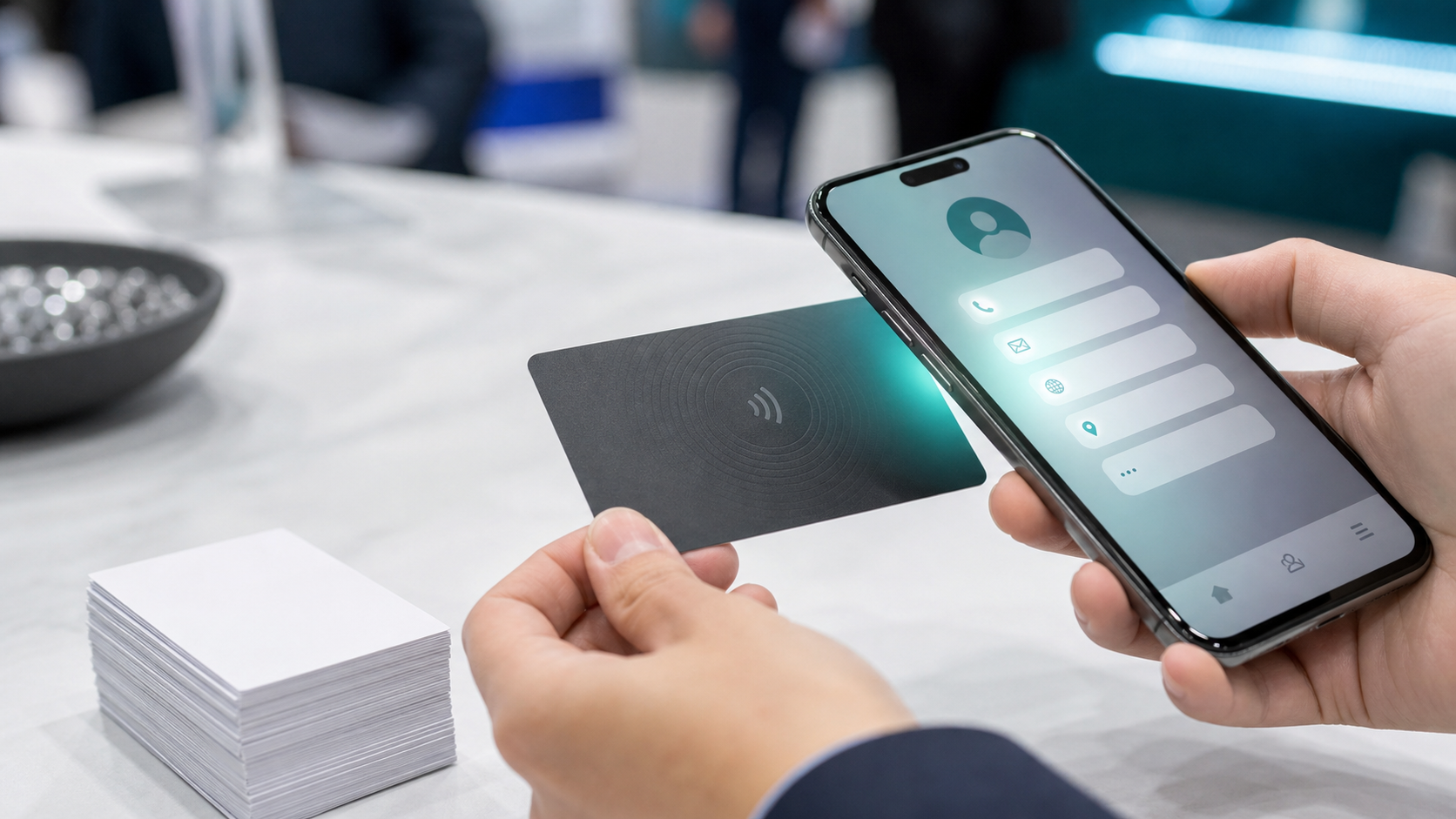
More brands are switching to NFC business cards because a card is no longer only a name, title, and phone number. For sales teams, event staff, hotels, franchise teams, and brand ambassadors, it has become a small offline-to-online touchpoint. A tap can open a contact profile, booking page, review link, product catalog, or lead form.
Paper business cards still work for quick introductions. They are low cost, familiar, and easy to hand out. The problem comes after printing: job titles, phone numbers, and landing pages change, while the card cannot show whether a conversation became a visit, saved contact, review, or inquiry.
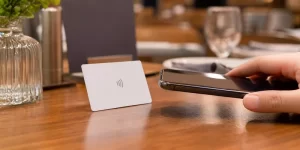
NFC cards solve part of that gap. According to the NFC Forum, Near Field Communication operates at 13.56 MHz and is designed for short-range contactless interaction. In practice, an NFC business card lets a recipient tap the card with a compatible smartphone and open a digital destination without typing a URL. That is why brands compare NFC cards with paper cards, QR code cards, and app-only digital cards.
Quick Comparison: NFC Business Cards vs Paper Cards
| Decision Point | NFC Business Cards | Traditional Paper Cards |
|---|---|---|
| First impression | Modern, interactive, useful for brand teams that want a stronger handoff | Familiar and simple, but easy to forget after an event |
| Information depth | Can link to a profile, vCard, website, booking page, product page, review page, or lead form | Limited to printed contact details and small design space |
| Updating details | The linked profile or URL can be updated without reprinting the card, if the card points to an editable destination | Usually requires a reprint when contact details or offers change |
| Lead capture | Can support forms, analytics, CRM workflows, or campaign pages depending on the digital platform used | Relies on manual follow-up and the recipient keeping the card |
| Best fit | Sales teams, trade shows, luxury service brands, recruitment, franchise teams, hospitality, review collection | Small runs, local networking, low-budget campaigns, situations where no phone interaction is expected |
Why Brands Are Moving Beyond Paper
The strongest reason is control. A paper card locks information at the moment of printing. An NFC card can point to a digital destination that changes as the campaign changes. A marketing team can update a seasonal landing page. A salesperson can adjust a calendar link. A hotel, restaurant, or clinic can direct customers to a review page or service menu. The physical card remains the same while the online experience stays current.
That matters at trade shows and sales meetings, where a buyer may meet dozens of suppliers in one day. A printed card goes into a bag with other printed cards. An NFC card can move the buyer to a contact save screen, product catalog, quote form, or follow-up page.
There is also a brand consistency benefit. A company can give each representative a card linked to an approved profile template, reducing outdated logos, old titles, and inconsistent contact details.
NFC Cards vs QR Code Business Cards
QR code business cards and NFC business cards often solve the same problem: they connect offline networking to online content. QR codes have one clear advantage. Almost every smartphone camera can scan them, and the user can see the printed code before interacting. That makes QR a practical backup, especially for older phones or users who have NFC disabled.
NFC has a different strength. The tap gesture feels faster and more premium when it works. The recipient does not need to open the camera app, frame the code, or wait for recognition. For high-touch sales, hospitality, luxury retail, and executive networking, that small difference affects how polished the interaction feels.
The best card design often uses both: encode the NFC chip with the primary URL, then print a small QR code as a backup.
NFC Cards vs App-Only Digital Business Cards
App-only digital cards are easy to update and do not require manufacturing, but they remove the physical handoff. NFC business cards keep that tangible moment while sending the recipient to a live digital profile, landing page, or lead form.
What Brands Should Check Before Ordering NFC Business Cards
An NFC card is simple for the end user, but the buying decision has technical and operational details. Before a bulk order, confirm these points:
- Destination: Decide whether the card should open a vCard, personal profile, company landing page, product catalog, Google review page, booking link, or lead form.
- Chip and encoding: Confirm the NFC chip type, memory needs, URL length, and whether each card needs the same URL or a unique employee/profile URL.
- Material: PVC cards are common for custom printing. Metal cards need special NFC design because metal can interfere with the antenna. For on-metal use, choose an NFC anti-metal construction.
- Printing and finish: Prepare artwork, logo, colors, card size, surface finish, QR backup, and any personalization fields.
- Testing: Request samples before a large run, especially if the card will use special material, thick finishes, epoxy, metal, or a unique encoding workflow.
- Team management: If sales or event teams need editable profiles and analytics, confirm the software platform before encoding production cards.
When Paper Cards Still Make Sense
NFC cards are not the right answer for every use case. Paper cards are still useful for low-cost mass distribution, short-term local events, inserts, or markets where recipients may not expect a phone interaction. They can also work well when the only goal is to leave a simple name and phone number.
The better question is: what should happen after the card is handed over? If the next step is a saved contact, product page, quote request, review, booking, or trackable campaign visit, an NFC business card has a stronger business case.
Why Custom Manufacturing Matters
Many online NFC card services focus on the digital profile platform. That is useful, but brands ordering in volume also need stable card quality, correct encoding, print consistency, and material selection. A card can look good but tap inconsistently if the chip, antenna, material, or surface treatment is not matched to the use case.
ASIARFID/Xinyetong manufactures custom RFID and NFC products for business buyers, including 13.56MHz RFID/NFC cards, NFC tags and labels, Google Review NFC cards, and NFC anti-metal tags. For NFC business card projects, the practical advantage is being able to discuss chip choice, card material, printing, QR backup, encoding data, samples, and production requirements before ordering.
FAQ
Do NFC business cards work with all smartphones?
They work with many modern NFC-enabled smartphones, but settings and device support vary. Print a QR backup for safer coverage.
Can I update the information after the card is printed?
Yes, if the chip points to an editable URL, profile, or landing page. Fixed contact data may require re-encoding or replacement.
Are NFC business cards better than QR code cards?
They are better for a fast, premium tap experience. QR codes are better for universal compatibility. Many brands use both on one card.
Can NFC cards be made with custom logo and colors?
Yes. Custom NFC cards can be printed with brand colors, logos, finishes, and different materials. Confirm artwork, material, chip, and encoding requirements before production.
Do metal NFC business cards need a special design?
Yes. Metal can interfere with NFC antenna performance, so metal cards or on-metal uses need the right structure and testing.
Conclusion
Brands are switching to NFC business cards because they connect a physical introduction to a digital next step. Compared with paper cards, they are easier to update, more useful for lead workflows, and better suited to measurable brand interactions. Compared with app-only digital cards, they keep the physical handoff that still matters in face-to-face business.
If you are planning a custom NFC business card project, send ASIARFID your artwork, quantity, preferred material, chip or encoding requirements, target URL, and whether you need QR backup or sample testing. The right card is more than a smart-looking print piece. It is a small, reliable bridge between the conversation and the action you want the buyer to take.