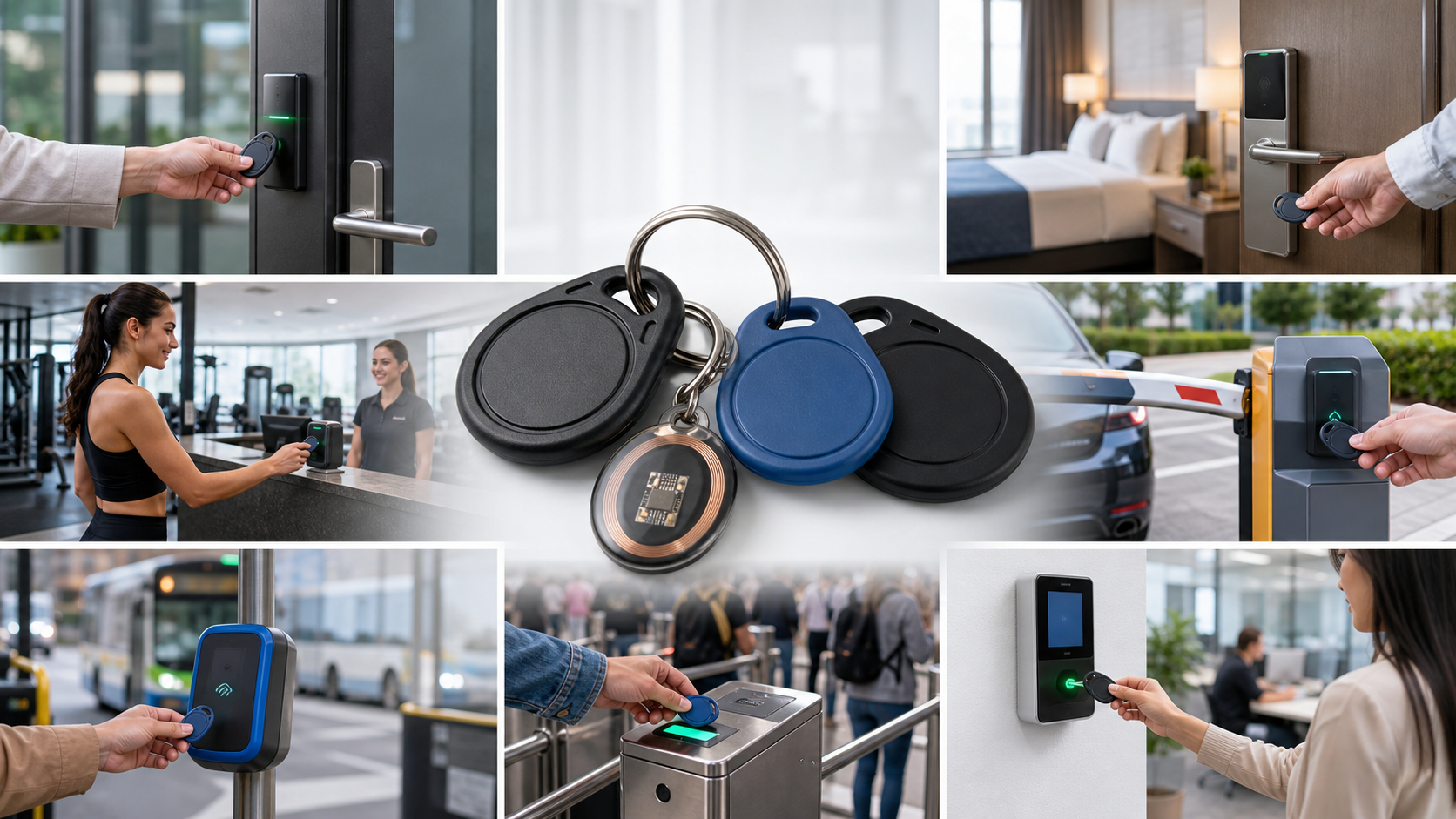
RFID key fobs are small contactless credentials used wherever people need quick, reliable identification. In real projects, they are most useful for access control, hotel rooms, gyms, parking gates, events, employee attendance, campuses, and shared facilities.
For buyers, the key question is not only where RFID key fobs can be used. It is which chip, frequency, material, encoding, and testing process will fit the system. This list explains seven practical RFID key fob applications and the sourcing decisions behind each one.
If you are planning a project, start with ASIARFID’s custom RFID key fobs and confirm your reader system, encoding data, artwork, and sample requirements before bulk production.
Quick Recommendation
| Application | Why RFID Key Fobs Work | Buyer Note |
|---|---|---|
| Access control | Fast tap-and-go entry | Confirm chip, data format, and security level |
| Hotels and resorts | Durable room and facility access | Test with real locks and encoders |
| Gyms and clubs | Simple member check-in | Plan printing, numbering, and database import |
| Parking | Controlled gate entry | Read range depends on the reader setup and gate layout |
| Events and venues | Entry, VIP zones, lockers, and payments | Compare key fobs with RFID wristbands |
What Is an RFID Key Fob?
An RFID key fob is a compact RFID credential with a chip and antenna sealed inside a small housing. It can be attached to a key ring, making it easier to carry every day than a card in many access-control and membership environments.
RFID key fobs can be made for LF, HF/NFC, or UHF systems, depending on the reader and application. The correct choice depends on system compatibility, memory, security needs, read distance, and how users will present the fob. Always test samples with the actual reader, antenna, mounting position, and workflow.
1. Building and Office Access Control
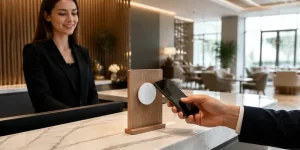
The most common RFID key fob application is door and gate access for offices, apartment buildings, factories, warehouses, laboratories, and gated communities. A user taps the fob on a reader, and the access system checks whether that credential is authorized.
For facility managers, key fobs are practical because they are compact, quick to issue, and easy to revoke when a tenant, employee, or contractor leaves. Before ordering, confirm the required chip family, UID format, facility code, encryption level, and encoding process.
2. Hotel, Resort, and Apartment Room Access
Hotels, resorts, serviced apartments, and student housing can use RFID key fobs for guest rooms, elevators, lockers, laundry rooms, gyms, and staff-only areas. A fob can be more durable than a thin card when users carry it with keys or handle it many times per day.
The main risk is compatibility. Do not assume that any RFID key fob will work with any hotel lock. Test samples with the real lock, encoder, and management software before placing a large order.
3. Gym, Club, and Membership Check-In
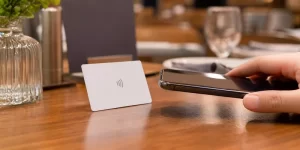
RFID key fobs are widely used by gyms, fitness studios, coworking spaces, private clubs, and membership-based facilities. Members can tap the fob at the front desk, self-service kiosk, turnstile, locker area, or after-hours door reader.
For the business, the benefit is faster check-in, fewer manual lookups, clearer attendance records, and easier access suspension or renewal. For the member, the experience is simple: keep the fob on a key ring and tap when arriving.
4. Parking Lots, Garages, and Vehicle Gate Access
RFID key fobs can manage parking access for residential communities, office parks, factories, campuses, hospitals, and private garages. They work best where the driver or passenger can stop or slow down near the reader.
For longer-range vehicle identification, windshield tags or vehicle-mounted RFID tags may be better than a hand-held fob. If the project involves metal surfaces or outdoor hardware, compare key fobs with anti-metal RFID tags and test in the real gate environment.
5. Events, Leisure Venues, and Cashless Experiences
RFID key fobs can support event entry, VIP access, locker use, staff authentication, rental equipment checkout, and cashless workflows at clubs, leisure venues, theme parks, and season-pass programs.
For single-day events, RFID wristbands may be more convenient because guests wear them. For staff, repeat customers, VIP members, and season-pass holders, key fobs can be a better long-term credential.
6. Employee Attendance and Time Tracking
RFID key fobs are also used for employee attendance, shift clock-in, contractor management, and visitor registration. Employees tap the fob at a time clock, kiosk, office reader, or gate terminal, and the system records the event.
This application is common in factories, warehouses, offices, schools, hospitals, and multi-site service teams. Buyers should prepare the numbering format, encoding file, employee assignment process, and replacement workflow before production.
Schools, universities, libraries, hospitals, clinics, and shared facilities can use RFID key fobs for classrooms, labs, dormitories, medicine rooms, equipment rooms, lockers, printers, and restricted service areas.
The advantage is flexibility. If the backend system supports it, one credential can connect a user to multiple touchpoints such as door access, attendance, locker use, and internal service authentication. For strict audit environments, confirm the access policy, revocation process, and data format with the system integrator.
How to Choose RFID Key Fobs for Your Project
Choose the RFID key fob from the system backward. First confirm the reader frequency, compatible chip, memory needs, data format, security requirements, and expected read distance. Then choose the housing style and customization: ABS, PVC, epoxy, color, logo printing, UID printing, laser numbering, QR code, barcode, or key ring accessory.
Request samples before mass production. Test them with your real readers, software, doors, gates, lockers, turnstiles, and user workflow. RFID performance can change with reader power, antenna design, orientation, nearby metal, water, installation position, and how users present the fob.
Why Source RFID Key Fobs from ASIARFID?
ASIARFID supplies RFID and NFC products for access control, membership, hotel, event, asset, and industrial projects. For key fob projects, you can discuss frequency, chip option, fob style, logo printing, numbering, encoding, sample testing, and bulk production requirements in one sourcing process.
Start from the RFID keyfob product page, or compare related formats such as RFID cards, RFID wristbands, and NFC tags and labels.
FAQ
What are RFID key fobs used for?
RFID key fobs are used for access control, hotel rooms, gyms, parking gates, event entry, employee attendance, campus facilities, lockers, and other contactless identification workflows.
Are RFID key fobs better than RFID cards?
They are better when users want a small credential attached to a key ring. RFID cards are better when a flat printed badge, photo ID, or wallet-friendly credential is needed.
Can RFID key fobs be customized?
Yes. Common options include housing style, color, logo printing, UID or serial number printing, laser marking, chip selection, encoding, and packaging.
Do RFID key fobs work with NFC phones?
Only some HF/NFC key fobs may interact with NFC phones. LF and many access-control fobs are not designed for phone interaction.
How do I know which RFID key fob to order?
Start with your reader or access system requirements. Confirm frequency, chip compatibility, data format, security level, and encoding. Then test samples before bulk production.
Can RFID key fobs be used outdoors?
Some key fob housings are suitable for demanding daily use, but outdoor performance depends on material, sealing, installation, and environmental exposure. Confirm the required protection level before ordering.
Conclusion
RFID key fobs are useful because they turn identification into a quick tap. The best applications include access control, hotels, gyms, parking, events, attendance, and shared facility management. To choose correctly, start with your reader system, confirm chip and encoding requirements, then test samples before mass production.
Send ASIARFID your application scenario, reader details, chip requirement, artwork, quantity, and encoding data to request RFID key fob samples or a project quote.