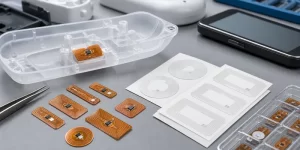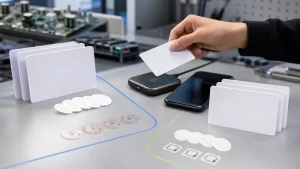
Mini FPC RFID tags and standard NFC/RFID stickers can both give a product a contactless identity, but they are built for different jobs. A sticker is usually the better choice when the tag needs to be printed, placed on a visible flat surface, and ordered at low cost. A mini FPC RFID tag makes more sense when the tag must be small, flexible, embedded, or hidden inside a product structure.
For buyers working on product authentication, electronics pairing, jewelry traceability, molded plastic parts, tray tracking, or compact branded devices, this comparison matters early. A late tag decision can force antenna compromises, awkward phone tap positions, or product redesign.
Quick Recommendation
Choose mini FPC RFID tags when the tag needs to sit inside a small product, bend around a shaped area, or survive secondary packaging and assembly better than a paper label. Choose RFID stickers or NFC labels when the tag should be printed, visible, easy to apply, and placed on packaging, cards, posters, boxes, or flat product surfaces.
| Decision Point | Mini FPC RFID Tag | Standard NFC/RFID Sticker |
|---|---|---|
| Best mounting style | Embedded, enclosed, or mounted in tight spaces | Surface-applied on flat packaging or labels |
| Visual branding | Usually hidden or covered by another layer | Easy to print with logo, text, QR code, or serial number |
| Space constraint | Useful for compact products and small cavities | Better when enough label area is available |
| Removal resistance | Can be integrated into molded parts or sealed products | Can be peeled or damaged if exposed |
| Prototype priority | Test antenna position, encapsulation, and tap behavior | Test adhesive, printing, encoding, and label placement |
What Is a Mini FPC RFID Tag?
A mini FPC RFID tag uses a flexible printed circuit material instead of a standard paper or PET label construction. ASIARFID’s 13.56 MHz mini FPC RFID tag page describes the tag as soft, flexible, lightweight, thin, and available in different sizes, chips, and shapes. The same page lists 13.56 MHz operation, FPC material, optional chips such as NTAG, MIFARE-compatible, and ICODE families, and protocols including ISO14443A/B, ISO15693, and ISO18092 depending on the chip.
The practical value is integration. ASIARFID notes that mini FPC RFID tags can be integrated into injection molded parts to help prevent labels from being removed or counterfeited. That makes them relevant for product authentication and traceability where a visible label is too easy to peel, copy, or damage.
How Mini FPC RFID Tags Work in a Product
Most mini FPC projects start with a product-design question: where can the antenna sit without being blocked by metal, liquid, dense electronics, or the user’s hand? Because the tag is small, even a few millimeters of position change can affect the tap result. Test samples inside the intended plastic, silicone, tray, case, or product housing, rather than judging performance from open-air scans.
For NFC-style use, the reader is often a smartphone. The NFC Forum describes NFC as a 13.56 MHz contactless technology centered on close tap interactions, with tags storing NDEF data such as web links or other actions. In practice, test the tag, encoded data, tap position, and mobile page together.
Mini FPC RFID Tags vs Stickers: The Real Trade-Offs
Size and antenna area: Mini FPC tags help when space is tight, but small antennas usually require stricter placement and closer reading. A larger NFC sticker may read more forgivingly on packaging because it has more antenna area.
Embedding and removal resistance: FPC tags fit embedded product authentication better. A sticker is faster to apply, but an exposed label can be removed, covered, scratched, or transferred. If the buyer wants the tag to become part of the product rather than part of the package, FPC deserves testing.
Printing and visible information: Standard stickers are better for visible branding. They can carry logos, usage instructions, QR codes, serial numbers, or regulatory text. FPC tags are usually chosen for function and integration, not for direct surface printing. If visible text is required, plan a printed overlay, outer label, or product marking separately.
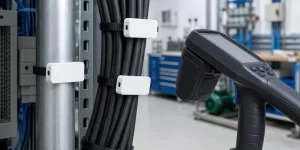
Metal and product materials: Neither tag type should be assumed to work on every surface. Metal, batteries, liquid, carbon-loaded plastic, and dense electronics can weaken HF/NFC performance. If the tag is near metal, ask whether a ferrite-backed or anti-metal construction is needed. ASIARFID’s anti-metal RFID tag options may be a better comparison point when the product body includes metal.
Best Applications for Mini FPC RFID Tags
Product authentication: A mini FPC tag can be placed inside a product shell, accessory, package insert, or molded part so the ID is harder to remove than a surface label.
Electronics pairing and setup: NFC can trigger app links, setup pages, service menus, or pairing records when the phone taps the product. Test the phone models and tap area because product shape affects user behavior.
Jewelry and small asset traceability: FPC tags can help when the tag must be discreet, light, and thin. For very small items, test read behavior before bulk production because antenna area is limited.
Molded plastic and silicone products: ASIARFID lists high-temperature injection molding, washing industry, silicone bracelet secondary packaging, tray management, and product authentication among mini FPC tag applications. For these projects, confirm the temperature, pressure, encapsulation method, and final reader workflow before ordering.
What to Prepare Before Ordering
Start with the physical product, then choose the chip. Send the supplier product photos, available tag space, mounting layer, nearby material, whether the tag will be visible or embedded, and whether the product will face heat, pressure, moisture, cleaning, or bending.
Next, define the data plan. Will the tag store a URL, product ID, serial number, authentication token, or database reference? If the system needs a specific chip family, memory size, protocol, UID behavior, or NDEF format, list that before sample production.
For printed stickers, prepare artwork and numbering rules. For mini FPC RFID tags, prepare placement drawings, overlay requirements, encoding files, and a sample test plan. A useful prototype check includes final-assembly reading, worst-case phone angle, and at least one sample after heat, pressure, or encapsulation when those steps are part of production.
Why Work With ASIARFID
ASIARFID supplies mini FPC RFID tags along with broader RFID tags, small RFID tags, NFC labels, RFID stickers, anti-metal tags, cards, key fobs, and wristbands. For a mini FPC project, the useful support is matching tag construction to product design rather than choosing by chip name alone.
Send your product drawing, target tag location, reader or phone requirement, chip preference, quantity estimate, and encoding rules. ASIARFID can prepare samples for size, tap behavior, assembly impact, and data-format checks before production.
FAQ
Are mini FPC RFID tags the same as NFC stickers?
No. They may use similar 13.56 MHz HF/NFC chips, but the construction and use case are different. Mini FPC RFID tags are designed for compact or embedded placement, while stickers are designed for surface labeling and print-friendly applications.
Can mini FPC RFID tags be read by smartphones?
They can be read by smartphones when the chip and encoded data are NFC-compatible and the phone can reach the antenna position. Test the final product assembly, not a loose tag alone.
Do smaller FPC RFID tags have shorter read range?
Often, yes. A smaller antenna usually gives less margin than a larger label, especially inside a product shell. Reader power, antenna position, material, phone model, and tag orientation all affect the final result.
Can mini FPC RFID tags be used near metal?
They may need ferrite backing, spacing, or a different anti-metal tag design if metal is close to the antenna. Send product material details and test samples before production.
What should I send for a quote?
Send the application, product photos or drawings, available tag space, frequency or chip requirement, encoding data, expected environment, sample quantity, and whether the tag will be embedded, covered, or surface-mounted.
Conclusion
Mini FPC RFID tags are not a direct replacement for every NFC or RFID sticker. They are a better choice when small size, flexibility, embedded placement, and removal resistance matter more than visible printing. Standard stickers remain the practical option for packaging, posters, flat products, and printed labels. For product-authentication or compact-device projects, request samples early and test the tag inside the real product structure before approving bulk production.