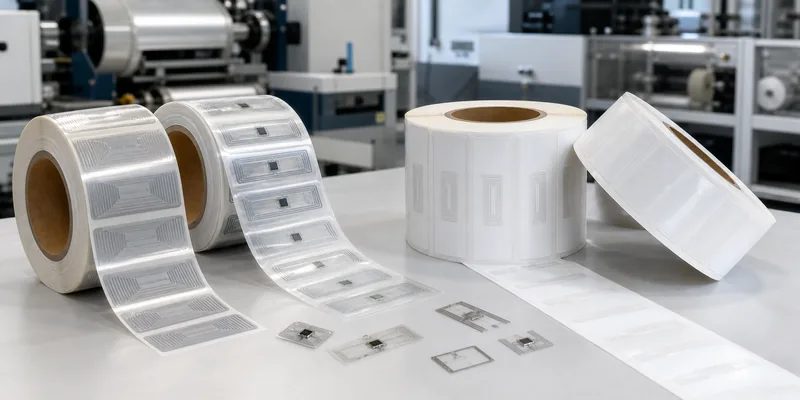
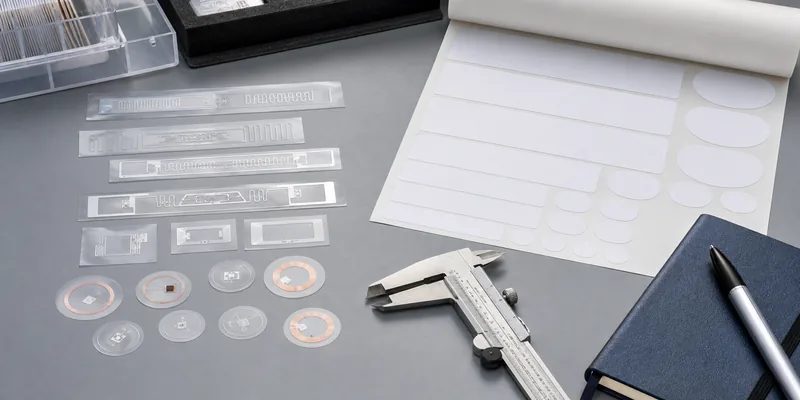
An RFID inlay and an RFID label are closely related, but they are not the same thing. The inlay is the functional RFID core: chip plus antenna, usually supplied as a dry inlay, wet inlay, sheet, or roll. The label is the finished item a worker can apply to a product, carton, asset, book, or package. It normally adds face material, adhesive, release liner, printing, encoding, and sometimes barcode or QR information.
For buyers, the practical question is not which term sounds more technical. The right choice depends on where the tag will be converted, how it will be attached, what surface it will touch, whether it needs printing, and how the tag will be read after application. If you order the wrong format, the chip may still be correct, but the production process or field installation can fail.
Quick Recommendation
Choose an RFID inlay when you are a converter, card maker, label producer, or manufacturer that will laminate, print, or build the inlay into another product. Choose a finished RFID label or sticker when your team needs a ready-to-apply tag for assets, cartons, books, garments, packaging, or marketing materials.
| Buying decision | RFID inlay | RFID label or sticker |
|---|---|---|
| Main purpose | Component for conversion or lamination | Finished tag for application |
| Typical buyer | Label converter, card factory, OEM, packaging supplier | Warehouse, retailer, library, brand owner, integrator |
| What to specify | Frequency, antenna size, chip, pitch, roll format, dry or wet construction | Frequency, face stock, adhesive, print layout, encoding, application surface |
| Best for | Custom labels, smart cards, tickets, packaging, embedded tags | Asset labels, NFC stickers, library labels, carton labels, product tags |
| Main risk | Inlay does not fit the converting process or target material | Adhesive, surface, print, or placement does not match the use case |
What Is an RFID Inlay?
An RFID inlay is the RFID working layer before it becomes a finished tag. It includes the IC chip and antenna structure on a substrate. Depending on the project, the inlay may be supplied as a dry inlay for further lamination, a wet inlay with adhesive, a prelam sheet for cards, or a roll format for label production. ASIARFID lists RFID inlay options including HF, NFC, UHF, wet inlay, card inlay, and small-format inlay examples.
The inlay affects read performance because the antenna geometry, chip selection, mounting material, and final tag structure all matter. A UHF inlay designed for a carton label is not automatically right for a small item label, a metal asset, or a card insert. Read range and read stability depend on reader power, antenna setup, tag orientation, surface material, spacing, nearby liquids or metal, and the way the inlay is converted into the final product.
What Is an RFID Label or RFID Sticker?
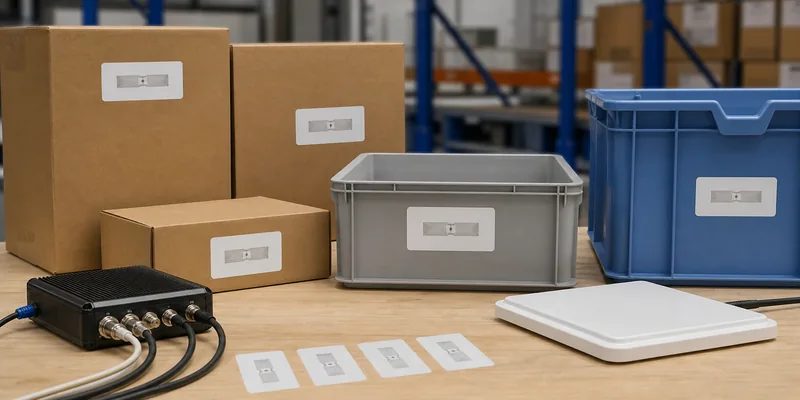
An RFID label or sticker is the finished usable format. It usually combines an RFID inlay with a printable face layer, adhesive, and liner. Buyers can specify shape, size, roll direction, printing, numbering, barcode, QR code, logo, and encoding requirements. ASIARFID’s RFID stickers page describes stickers as a structure with surface layer, inlay, adhesive layer, and backing layer, and positions them for packaging labels, asset labels, clothing labels, and item tags.
This extra structure is why label questions are more practical than chip questions alone. A label may need to stick to cardboard, plastic, glass, fabric, paper, or a curved product. If the application surface is metal, a standard label may perform poorly unless an anti-metal construction is chosen. If the label goes through a printer, the roll core, winding direction, label gap, face stock, and printer compatibility also need to be checked before bulk ordering.
How to Choose Between RFID Inlay and Finished Label
Start with the production workflow
If your supplier or factory will embed the RFID part into a card, ticket, package, hang tag, or custom label construction, ask for inlays. If your workers will apply the tag directly to an asset or package, ask for a finished label. This sounds simple, but it prevents a common ordering mistake: buyers ask for an inlay when they actually need printable and adhesive labels ready for deployment.
Match the frequency to the reader and use case
HF and NFC are common for short-range phone interaction, library systems, access cards, smart posters, and product authentication where close tapping is expected. UHF is usually considered when many items need to be read quickly at a longer distance, such as cartons, inventory, warehouse labels, retail items, or asset tracking. LF, HF/NFC, and UHF are not interchangeable. The reader, software, region, antenna design, and operating environment must support the selected tag.
Check the surface before selecting adhesive or antenna
Surface material can change the result more than buyers expect. Paper cartons and many plastics are usually easier than metal housings, liquid-filled products, foil packaging, or dense stacks of goods. For metal or high-interference surfaces, review anti-metal RFID tags or NFC anti-metal options instead of assuming a standard inlay will work after lamination.
Decide whether printing and encoding are required
Finished labels often need readable information for staff as well as RFID data for the system. That may include a barcode, serial number, human-readable ID, logo, or product code. Encoding also needs a clear rule: what data is written, how it maps to the database, whether lock/password settings are needed, and whether each roll should be read-after-write checked before shipment.
Buyer Checklist Before Ordering
- Confirm the reader frequency, protocol, and software data format before choosing an inlay or label.
- Share the application surface: cardboard, plastic, glass, fabric, paper, metal, liquid package, or curved item.
- Define the target workflow: single-item scan, batch inventory, conveyor read, phone tap, checkout, access, or authentication.
- Specify label size, roll format, core size, winding direction, print layout, and printer model if labels will be printed.
- Prepare encoding rules, serial number format, barcode or QR mapping, and database requirements.
- Request samples for real mounting and reader tests before bulk production.
Common Application Examples
For warehouse cartons, a finished UHF label may be easier to deploy because staff can apply it directly and scan many cartons in batches. For product packaging, an NFC wet inlay may be converted into a branded label or tamper-aware package design. For libraries, thin HF labels need to fit books without creating handling problems. For smart cards, prelam sheets or card inlays are usually more relevant than finished adhesive labels. For broad product exploration, start from ASIARFID’s RFID tags category and narrow the format from there.
Why Work With ASIARFID
ASIARFID can support buyers who are still deciding between an inlay, sticker, card inlay, NFC label, UHF label, or anti-metal tag format. The useful starting point is a clear application brief: reader type, item material, expected read workflow, environment, printing, encoding, and sample test plan. With that information, the recommendation can focus on tag construction and real deployment risk instead of a generic chip list.
If the project is NFC-based, compare NFC tags and labels with finished sticker formats. If the project is card-based, review RFID cards or 13.56MHz RFID/NFC cards instead of starting from roll inlays. The best choice is the format that survives production, sticks properly, reads reliably, and fits the system data workflow.
FAQ
Is an RFID inlay the same as an RFID label?
No. The inlay is the RFID core with chip and antenna. A label adds usable layers such as face stock, adhesive, liner, printing, and sometimes encoding. A finished label is ready to apply; an inlay is often meant for further conversion.
Should I buy dry inlay or wet inlay?
Dry inlay is usually chosen for lamination or further manufacturing. Wet inlay includes adhesive and is closer to a sticker component. The right choice depends on the converting process, not only the RFID chip.
Can the same RFID inlay be used on metal and cardboard?
Not safely without testing. Metal can detune or block standard RFID designs. For metal surfaces, choose an anti-metal construction or test samples under the same mounting conditions before ordering.
Do RFID labels need encoding before shipment?
Many projects do. Encoding should be defined by the software or database requirement. Buyers should provide the data format, sequence rules, and any lock or password requirements before production.
Can NFC inlays be used for product packaging?
Yes, when close-range phone interaction is the goal. The chip memory, URL or data structure, material, adhesive, package surface, and phone-tap position still need to be checked.
How should I test RFID labels before bulk ordering?
Apply samples to the real item, use the actual reader or phone, test the intended scan distance and orientation, and check several locations on the product. For UHF labels, also test group reading and nearby interference.
Conclusion
RFID inlays and RFID labels solve different parts of the same project. Inlays are the right starting point for conversion, lamination, and embedded RFID products. Finished labels are better when the buyer needs a ready-to-apply tag with adhesive, printing, encoding, and a known deployment surface. Before ordering, confirm the frequency, surface, format, printer or converter requirements, encoding rules, and sample test conditions. That preparation is usually more important than choosing the lowest-cost chip.