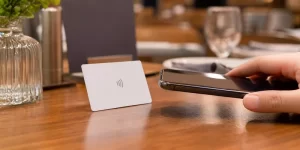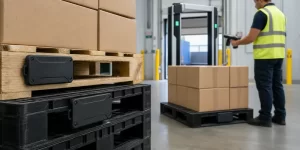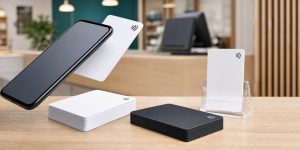
NFC menu cards turn a restaurant table, counter, hotel room, or takeaway package into a tap point for a digital menu. A guest taps the card with a compatible smartphone and opens a menu, ordering page, booking page, loyalty form, or campaign link. The idea looks simple, but the purchase decision needs more than a nice card design.
Before a bulk order, confirm the phone-tap experience, card material, chip memory, URL format, artwork, cleaning routine, table placement, and QR backup. A sample that works on a desk may fail in a dining room if the holder blocks the antenna, the table surface contains metal, or the restaurant changes menu software without redirect control.
Quick Recommendation
For most restaurant projects, start with a 13.56 MHz NFC card or NFC sticker encoded with a short, stable menu URL. Print a QR backup on the same card or display so guests without NFC, guests with NFC disabled, or older phones can still open the menu. Approve production only after testing samples in the real placement.
| Buyer decision | Safer starting point | What to test before bulk order |
|---|---|---|
| Form factor | PVC NFC card, laminated table card, NFC sticker, or acrylic tabletop insert | Tap position, durability, cleaning, table fit |
| Chip/memory | NTAG-style NFC chip for simple URL projects | URL length, NDEF encoding, lock/read settings |
| Digital destination | Short menu URL with redirect control | Menu speed, mobile layout, language switching |
| Backup access | QR code beside the NFC tap area | Camera scan distance and table lighting |
| Surface | Wood, laminate, acrylic, glass, or metal table setting | NFC read consistency and placement |
| Branding | Logo, colors, table number, icons, or plain design | Print proof, orientation, guest instructions |
NFC menu cards are physical cards, stickers, or tabletop signs with an embedded NFC chip. The chip is usually encoded with a URL. When a compatible smartphone taps the NFC area, the phone reads the tag and opens the linked digital menu or web page.
NFC operates at 13.56 MHz and is designed for short-range tap interaction. That short range is useful in restaurants because the guest intentionally taps the table card instead of accidentally reading it from far away. In practice, the result still depends on phone model, NFC settings, case thickness, antenna position, card material, and table surface.
NFC menu cards are not ordering software by themselves. They are the physical access point. The restaurant still needs a mobile-friendly menu, ordering system, review page, loyalty page, or landing page behind the URL.
NFC Card, NFC Sticker, Or Tabletop Stand?
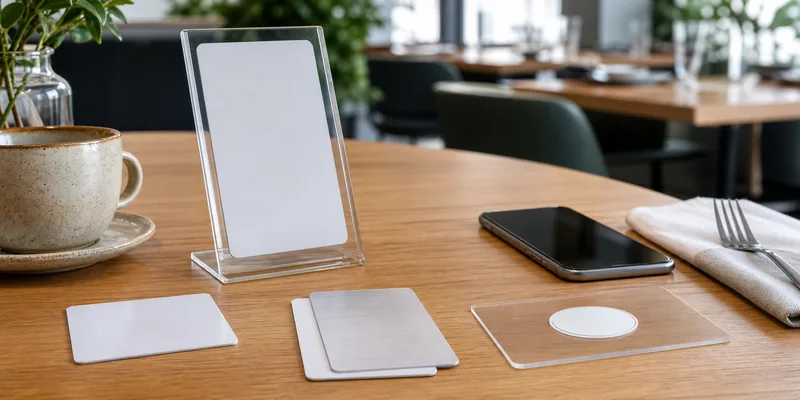
A PVC NFC card works well when the card is handed to the guest, placed in a bill folder, included in a hotel room, or used as a durable branded leave-behind. It is easy to print, stack, encode, and replace.
An NFC sticker is better when the restaurant wants a fixed tap point on a table tent, acrylic sign, counter display, takeaway bag, or printed menu board. Adhesive matters. Grease, cleaning chemicals, curved surfaces, and frequent wiping can shorten the usable life if the sticker is not chosen for that environment.
A tabletop stand makes the tap point easier to notice, but the holder must not block the NFC antenna. Test acrylic thickness, metal clips, laminates, and decorative holders before approving the final structure.
What Restaurants Should Check Before Ordering
Start with the workflow, not the design. Decide what happens after the tap: view menu, order online, call staff, join Wi-Fi, collect loyalty data, request a review, or open a seasonal campaign. Each destination changes the encoding and design requirements.
Keep the NFC payload short when possible. A short URL is easier to encode and manage than a long tracking link. If the marketing team needs analytics, use a stable redirect URL that can point to the current menu page. This avoids re-encoding every card when the menu platform changes.
Plan for real phones. Many modern smartphones can read NFC tags, but behavior varies by model, settings, case thickness, and antenna location. A visible QR backup is the safer public-facing choice.
Check metal early. Standard NFC cards may perform poorly on stainless counters, metal table signs, or metallic holders. If the tag must sit on metal, ask for an NFC anti-metal construction and test it in the exact placement.
Cleaning is also part of the specification. Table cards may be wiped many times per day. Confirm card material, laminate, print method, edge finish, and whether the planned cleaning method may affect the print or adhesive.
Sample Testing Checklist
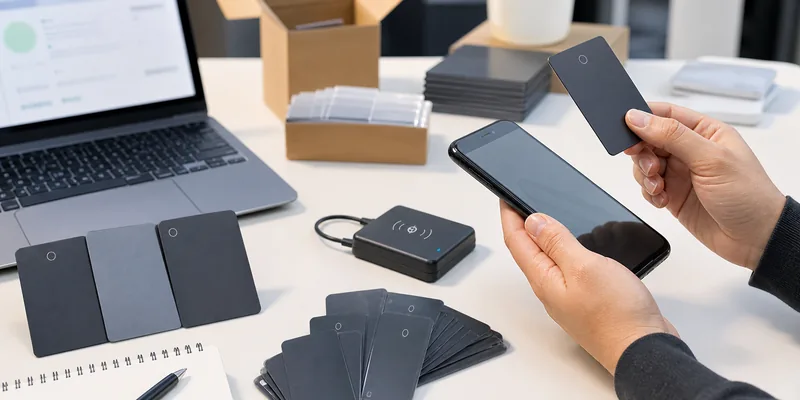
Before bulk production, request samples that match the final material, size, chip, printing method, and surface finish as closely as possible.
Test each sample with:
- iPhone and Android phone models used by typical guests.
- The final menu URL, not a temporary placeholder.
- The real table, holder, counter, wall, or hotel-room placement.
- Phone cases, table lighting, guest angle, and one-handed tapping.
- Cleaning and wiping after repeated handling.
- QR backup distance and visibility.
- Table numbering, language versions, and multi-location URL logic.
- Staff replacement workflow when a card is lost or a table number changes.
If a restaurant group has multiple locations, decide whether all cards use one menu link, one link per location, one link per table, or one encoded ID per card. That decision affects printing, encoding files, quality control, and future maintenance.
Common Restaurant Applications
Digital menu access is the core use. Guests tap the NFC card and open a web menu without typing a URL. This fits cafes, quick-service restaurants, hotel breakfast areas, bars, food courts, and seasonal menus.
Ordering and payment workflows can also start from an NFC card, but the card itself does not process payment. It only opens the selected online destination. The ordering or payment platform must handle the transaction.
Hotels and resorts can use NFC cards in rooms, lobbies, restaurants, spas, and pool bars. A single card can open a room-service menu, facility map, booking page, or guest feedback page, depending on the encoded URL.
Why Work With ASIARFID
ASIARFID supplies RFID and NFC products that can support restaurant menu-card projects, including 13.56MHz RFID/NFC cards, NFC tags and labels, Google Review cards, and NFC anti-metal tags for difficult surfaces. For a practical order, the useful support is confirming chip choice, card or sticker format, URL encoding, artwork, QR backup, sample testing, and packaging before bulk production.
If you are preparing an NFC menu card project, send ASIARFID your card size, material preference, artwork, menu URL, table-numbering plan, quantity, expected placement, and whether the card will sit near metal.
Relevant ASIARFID product pages:
- Custom 13.56MHz RFID/NFC cards: https://www.asiarfid.com/13-56mhz-rfidnfc-cards.html
- NFC tags and labels: https://www.asiarfid.com/nfc-label.html
- Google Review NFC cards: https://www.asiarfid.com/google-review-cards.html
- NFC anti-metal tags: https://www.asiarfid.com/nfc-anti-metal-tags.html
- RFID cards: https://www.asiarfid.com/rfid-cards.html
FAQ
No. Many modern smartphones can read NFC tags, but phone model, NFC settings, case thickness, operating system behavior, and tap position can affect the result. Print a QR backup for safer guest access.
For a simple menu URL, a common NFC tag chip with enough memory for the encoded link is usually sufficient. Confirm the exact chip and memory after you know the URL length, whether the data should be locked, and whether each card needs a unique link.
Yes, if the URL system is planned correctly. A restaurant group can use one shared link, location-specific links, table-specific links, or serialized card IDs. Decide this before printing and encoding.
Should restaurants use NFC only or NFC plus QR code?
Use both for most public-facing restaurant projects. NFC gives a fast tap experience when it works. QR gives a visible fallback for guests whose phones do not read NFC easily.
They can be reused if the encoded URL stays stable and the restaurant updates the destination page or redirect. If the original URL changes and there is no redirect control, cards may need re-encoding or replacement.
Do NFC cards work on metal tables?
Standard NFC cards may perform poorly on or near metal. If the card must be mounted directly on metal, test an NFC anti-metal tag or a spacer design in the real placement.