RFID medical equipment tracking tags help hospitals, clinics, biomedical engineering teams, and healthcare asset managers identify movable equipment faster than manual label checks alone. A reliable project still needs the right reader setup, asset database, tag placement, encoding plan, and sample test in the real hospital environment.
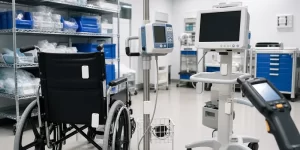
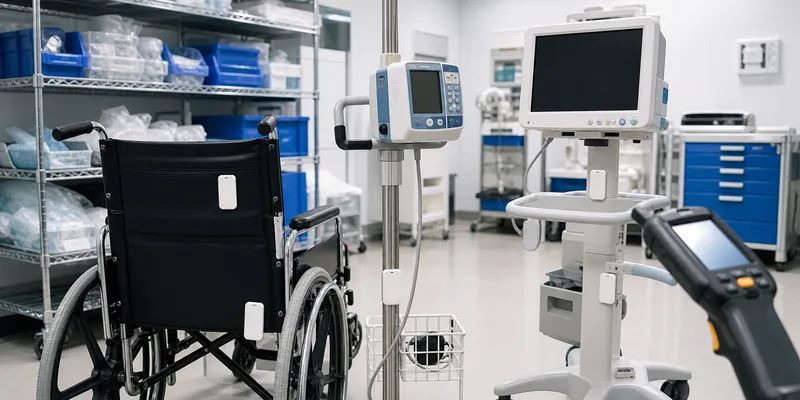
Start with assets that move often and are expensive to locate manually: wheelchairs, infusion pump stands, portable monitors, beds, carts, reusable containers, and service tools. Then choose the tag around the surface, cleaning routine, expected read zone, and whether staff will use handheld audits, doorway reads, cabinet checks, or close-range tap scans.
Quick Recommendation
Use standard RFID labels only when the surface is clean, flat, non-metal, and protected from heavy abrasion. Use an anti-metal RFID tag or spacer-backed design when the tag must be attached to metal carts, wheelchair frames, monitor stands, cabinets, or equipment housings. Before bulk production, test samples with the actual reader, antenna, asset surface, mounting position, cleaning process, and workflow.
| Buying Question | What To Check | Why It Matters |
|---|---|---|
| What equipment will be tagged? | Wheelchairs, pumps, monitors, carts, beds, tools, bins, or cabinets | Shape, surface, handling, and cleaning exposure change the best tag format. |
| Is the surface metal? | Metal frame, stainless cart, painted metal, plastic housing, glass, or curved surface | Metal can detune ordinary labels; anti-metal tags are often required. |
| How will staff read the tag? | Handheld inventory, doorway read, room zone, cabinet, desk encoder, or maintenance station | Read performance depends on reader power, antenna, orientation, distance, and interference. |
| What data is needed? | UID only, encoded asset ID, serial number, department, or database mapping | Encoding and printed numbering should match the asset-management system. |
| What is the cleaning exposure? | Wipe-down chemicals, moisture, abrasion, heat, or sterilization process | Tag material and adhesive need to survive the real handling environment. |
RFID medical equipment tracking tags are passive RFID labels or hard tags attached to healthcare assets so readers can identify them without a direct barcode scan. The tag usually presents an identifier, and the asset-management system connects that ID to records such as asset name, department, maintenance status, or audit history.
HF/NFC tags can suit close tap checks. UHF RFID tags are often considered for faster inventory reads or portal-style read zones, but UHF performance is more sensitive to surface material, reader setup, antenna position, tag orientation, liquids, metal, and nearby equipment. Do not approve a tag from a catalog image alone.
ASIARFID supplies related product categories such as RFID tags, RFID stickers, anti-metal RFID tags, UHF flexible anti-metal tags, and small RFID tags. The final choice should still be matched to the installed reader and asset workflow.
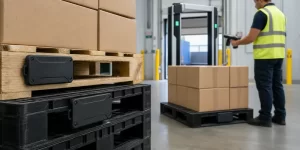
RFID tags are useful when staff need to identify many items quickly or confirm that an asset is present in a defined area. Handheld readers can support audits of storage rooms, equipment closets, wards, and service areas. Fixed readers may be used around doorways, cabinets, or controlled zones when the workflow is designed for that read point.
A passive RFID label does not automatically give exact real-time location across an entire hospital. Room-level or real-time workflows need reader infrastructure, antenna placement, software logic, and the right tag choice. For ASIARFID tag sourcing, the practical goal is to specify a tag that reads reliably in the intended workflow.
How To Choose the Right Tag
Start with the asset surface
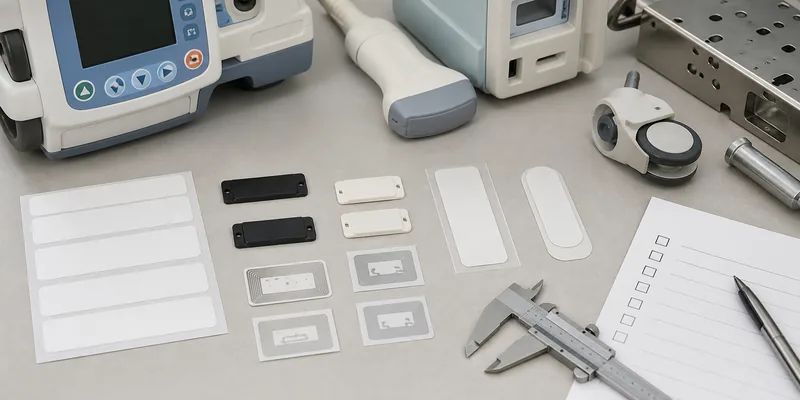
List the equipment by material before choosing a tag. Plastic housings, painted metal carts, stainless cabinets, rubberized handles, and curved wheelchair frames behave differently. A flat RFID sticker may work on plastic, while metal surfaces usually need an anti-metal tag or a spacer-backed design. If the asset has curved or narrow mounting areas, test realistic sample sizes.
Match frequency to the workflow
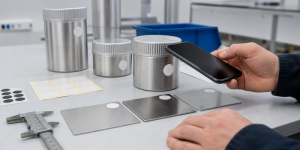
HF/NFC can make sense when staff tap or scan individual assets at close range. UHF can support faster multi-item reads, storage-room audits, or doorway-style read zones when antennas and tags are selected carefully. The correct frequency is the one the hospital reader infrastructure and software support.
Decide how rugged the tag must be
Medical equipment tags may face repeated handling, cleaning wipes, moisture, transport vibration, and impact from carts or storage racks. Ask what material, adhesive, encapsulation, or mechanical fixing method is available, then test it on a sample asset. High heat, autoclave, harsh chemicals, or regulated sterilization are separate requirements that must be confirmed before production.
Plan encoding and visible ID together
Many buyers need both electronic identification and visible control. The tag may carry a UID or encoded asset ID, while the printed surface shows a serial number, barcode, department code, or maintenance reference. Align the encoding file, printed numbering, and asset database before production.
Test the read zone before scaling
Sample testing should include the real reader, antenna, mounting location, asset orientation, staff handling method, and nearby materials. One tag in an empty room is not enough if the real environment includes stacked carts, metal shelves, batteries, liquids, or dense equipment. Record which positions read consistently and which fail.
Common Healthcare Equipment Use Cases
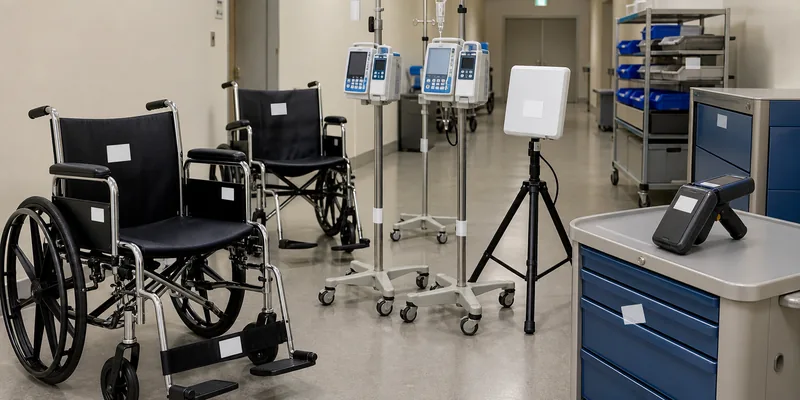
- **Movable equipment audits:** Wheelchairs, portable monitors, infusion pump stands, beds, and carts can be tagged so staff can audit rooms or storage zones faster than checking each barcode by hand.
- **Biomedical maintenance:** RFID IDs can connect equipment to inspection, calibration, repair, or service records when the asset-management software supports that process.
- **Storage-room and cabinet checks:** RFID can help confirm whether tagged assets or reusable containers are present in a cabinet, store room, or equipment bay. The read zone must be tuned to avoid missed reads and unwanted nearby reads.
- **Department-level asset control:** Tags can support ownership, movement logging, or return workflows. Privacy and clinical system rules belong in the hospital software and policy, not in tag assumptions.
What To Prepare Before Requesting a Quote
- Asset list with photos and surface notes.
- Reader type, frequency, antenna layout, software requirement, and encoding format if known.
- Expected workflow: handheld audit, doorway read, cabinet read, maintenance check, or close tap.
- Mounting location on each asset type, including flat, curved, plastic, metal, or hidden areas.
- Cleaning exposure, moisture, abrasion, heat, chemicals, or sterilization requirements.
- Printed numbering, barcode, QR code, department code, or serial matching rules.
- Sample test plan covering real equipment, reader distance, orientation, stacked assets, and cleaning.
Where ASIARFID Fits
ASIARFID can help buyers compare adhesive RFID labels, small hard tags, anti-metal tags, and flexible on-metal formats for healthcare equipment and other asset-tracking projects. The most useful inquiry includes asset photos, surface material, reader system, mounting position, cleaning environment, and encoding requirement.
If compatibility is uncertain, request samples across RFID stickers, anti-metal RFID tags, UHF flexible metal tags, or small RFID tags and test them before a bulk order.
FAQ
RFID can support equipment tracking, but real-time location depends on the whole system: tag type, reader infrastructure, antenna placement, software, and workflow. A passive tag by itself does not guarantee exact hospital-wide location.
Which RFID frequency is best for hospital asset tracking?
There is no universal best frequency. HF/NFC can fit close tap checks, while UHF can fit faster inventory or portal-style reads.
They often do on metal carts, frames, stands, cabinets, or device housings. Test anti-metal tags or spacer-backed options on the real asset.
Cleaning resistance is not universal. Share the cleaning method, chemicals, moisture, abrasion, and temperature conditions before selecting a tag.
Should the tag store full equipment information?
Usually the safer approach is to read a stable identifier and keep detailed records in the hospital database. Confirm memory, encoding format, and privacy rules with the system owner.
What should we test before approving bulk production?
Test read consistency, mounting position, adhesion, cleaning exposure, printed ID matching, encoding accuracy, and performance near metal shelves, carts, batteries, liquids, and dense equipment.
Schema Recommendation
Use Article schema for the post and FAQPage schema only for the visible FAQ section. Do not add Product schema unless the final page includes verified SKU-level product data such as model, price, availability, or review fields.
Facts and Assumptions To Verify
- Confirmed from ASIARFID site structure: relevant internal product pages include RFID Tags, RFID Stickers, Anti-Metal Tags, UHF Flexible Anti-Metal Tags, and Small RFID Tags.
- Assumption: the target reader is a hospital buyer, clinic operator, biomedical engineering team, healthcare distributor, or system integrator comparing RFID tags for equipment asset tracking.
- Verify before production: exact reader frequency, protocol, chip, memory, tag size, adhesive, chemical resistance, sterilization exposure, read-zone layout, encoding rules, and sample test result.
Conclusion
The best RFID medical equipment tracking tag is chosen from the workflow backward. Start with the assets, surfaces, cleaning exposure, reader system, and read zone. Then compare standard labels, small hard tags, anti-metal tags, and flexible on-metal options through sample testing.
To prepare an ASIARFID quote, send asset photos, reader details, surface materials, cleaning conditions, quantity estimate, and encoding requirements. If compatibility is uncertain, request samples and test them on the real equipment before approving bulk production.