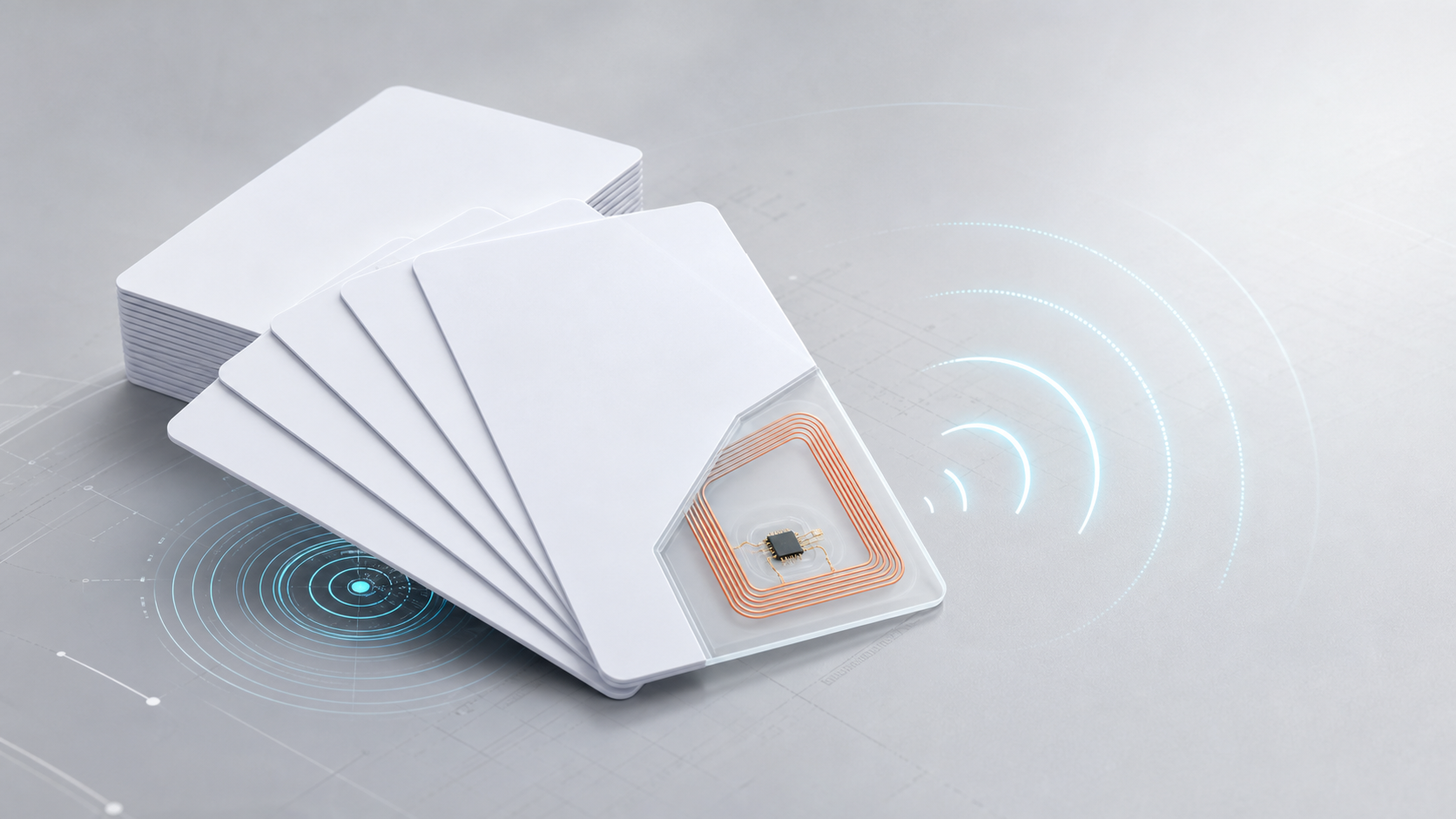
RFID blank cards look simple, but the real specification is inside the card: size, material, antenna design, chip type, frequency and encoding. For access control, hotel, membership, campus and identification projects, the first decision is whether the card should work as LF, HF/NFC or UHF.
As a quick rule, choose 125 kHz LF RFID blank cards for short-range legacy access systems, 13.56 MHz HF/NFC cards for contactless cards and smartphone tap use, and 860-960 MHz UHF cards for longer-range identification with a UHF reader. Read range is not fixed by the card alone. It depends on reader power, antenna design, card orientation, chip sensitivity, nearby metal or liquid, and the software workflow.
This reference summarizes the RFID blank card specifications to confirm before samples or bulk production.
Quick Specification Snapshot
| Specification | Common option | What buyers should confirm |
|---|---|---|
| Card format | CR80 / ID-1 card format | Exact size tolerance and printer compatibility |
| Common size | 85.5 x 54 mm, often referenced as 85.60 x 53.98 mm ID-1 | Custom size, thickness or shape requirements |
| Material | PVC, PET or composite options | Printing method, durability and temperature needs |
| Frequency | LF 125 kHz, HF/NFC 13.56 MHz, UHF 860-960 MHz | Reader frequency and system protocol |
| Surface | Plain white, printable, inkjet printable or pre-printed | Logo, numbering, QR code, barcode or artwork |
| Encoding | UID only, custom data, URL, access number or EPC | Data format, lock rules and test reader |
ISO/IEC 7810 defines identification-card physical characteristics. ASIARFID also lists CR80 85.5 x 54 mm as a standard size for 125 kHz RFID blank cards.
RFID Blank Card Sizes
Most RFID blank cards are made in CR80 format because it works with access-control cardholders, hotel card wallets, desktop card printers and standard card packaging. The common factory description is 85.5 x 54 mm. Buyers may also see the ISO ID-1 reference of 85.60 x 53.98 mm.
Thickness is selected according to the application. A rigid PVC card for access control or membership is often produced close to payment-card feel, while thinner cards may be used for tickets or inserts. If the card will be printed after delivery, confirm card thickness, surface coating and printer type. Inkjet-printable blank cards need a different coating from ordinary white PVC cards.
Custom sizes are possible, but they can change RF performance. A smaller card gives less antenna area, while a long-range UHF card may need a larger or carefully tuned antenna. Test the final size and chip together when read distance matters.
Chip and Frequency Options
The chip must match the reader and the job. A card with the wrong frequency may look correct but fail completely in the field.
| Frequency | Typical chip options | Best-fit applications | Read behavior |
|---|---|---|---|
| LF 125 kHz | TK4100, EM4200, EM4305, T5577, HITAG options | Door access, attendance, parking, legacy ID systems | Short range and stable for many daily-use environments |
| HF/NFC 13.56 MHz | MIFARE-compatible chips, MIFARE Ultralight, NTAG213/215/216, ISO14443 or ISO15693 options | Hotel cards, membership, NFC business cards, ticketing, loyalty and campus cards | Tap or near-field use; ISO15693 can reach farther with suitable readers |
| UHF 860-960 MHz | UHF Gen2 / ISO18000-6C options such as Alien H3-style card products | Logistics, inventory, vehicle ID, warehouse and long-range identification | Longer range, but more sensitive to environment and orientation |
LF cards are often chosen when an existing access system already uses 125 kHz cards. ASIARFID lists 125 kHz blank cards with TK4100, EM4200, EM4305, T5577 and related LF chips, with a listed reading distance of 0-10 cm.
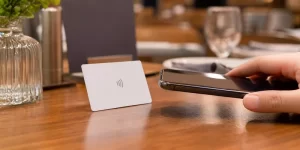
HF and NFC cards cover the widest range of card projects. NFC cards for URLs, digital profiles, Google reviews or phone interaction usually use NTAG213, NTAG215 or NTAG216. The NXP NTAG213/215/216 data sheet identifies these ICs as NFC Forum Type 2 Tag compliant and ISO/IEC 14443 Type A compatible, with 144, 504 and 888 bytes of user memory. For access, ticketing or hotel systems, buyers may need MIFARE-compatible or other ISO14443 options. For library or asset workflows, ISO15693 HF cards may be more suitable.
UHF cards are not for smartphone tapping. They are used when a UHF reader needs to identify a card at longer distance or in batches. The GS1 EPC Gen2 UHF RFID standard covers air-interface communication in the 860 MHz to 960 MHz band, while many commercial UHF RFID card pages use the broader 860-960 MHz regional range. Confirm operating region, reader settings and chip memory before production.
RFID Card Read Range
Read range should be treated as a test result, not a fixed catalog number. The same RFID blank card may read differently with a desktop encoder, wall-mounted access reader, handheld reader or fixed UHF gate antenna.
| Card type | Practical range expectation | Main variables |
|---|---|---|
| LF 125 kHz blank card | Usually close range; ASIARFID lists 0-10 cm for its 125 kHz blank card | Reader field strength, chip type, card orientation |
| HF/NFC 13.56 MHz card | NFC phone tapping is normally very close; ASIARFID’s HF category states 10 cm to 1 m depending on card and reader type | ISO14443 vs ISO15693, phone or reader antenna, encoded task |
| UHF 860-960 MHz card | Can reach much farther than LF/HF; ASIARFID lists up to 33 ft for selected UHF card designs | UHF antenna, reader power, local regulations, human body blocking, metal and liquid nearby |
If a supplier promises one universal read range for every card, ask for the test conditions: reader model, antenna gain, reader power, card orientation, mounting surface, distance method and whether the card was read alone or in a stack.
How to Choose the Right Blank RFID Card
Start with the system, not the card surface. If your reader is already installed, send the reader model, frequency and sample card data to the supplier. If the project is new, define the user action first: tap a phone, open a door, check in at a hotel, identify a member, track an item or read cards from a distance.
Choose LF when compatibility with an existing 125 kHz access or attendance reader matters more than memory or mobile interaction. Choose HF/NFC when the card needs close contactless use, smartphone reading, secure card functions or printed membership-card workflows. Choose UHF when the card must be read from a longer distance by a UHF RFID system.
For printed blank cards, confirm whether you need normal PVC, inkjet-printable PVC, full-color pre-printing, numbering, barcode, QR code, magnetic stripe, signature panel or encoding before shipment.
What to Prepare Before Ordering
- Required frequency and reader model.
- Chip model or current sample card.
- Card size, thickness and material.
- Surface type: plain white, printable, inkjet printable or custom printed.
- Encoding data, UID requirements, URL or EPC format.
- Expected read range and real installation environment.
- Quantity, packaging and delivery requirements.
For performance-sensitive projects, test the exact chip, antenna, card size and reader setup before mass production.
Why Work With ASIARFID
ASIARFID supplies RFID blank cards across LF, HF/NFC and UHF categories, including 125 kHz RFID cards, 13.56 MHz RFID/NFC cards and 860-960 MHz UHF cards. Buyers can request help with chip selection, material, printing, encoding and sample testing.
If you are not sure which chip fits your reader, send your application, reader model, current card sample or encoding requirements. ASIARFID can recommend a practical option for testing.
FAQ
What is the standard size of an RFID blank card?
The most common format is CR80, commonly described as 85.5 x 54 mm. It is close to the ISO ID-1 card format used for many identification cards.
Which RFID blank card works with smartphones?
Use a 13.56 MHz NFC card with a phone-compatible chip such as NTAG213, NTAG215 or NTAG216 for URL, profile, review or simple NDEF use. LF and UHF cards are not general smartphone-tap cards.
Is MIFARE the same as NFC?
No. MIFARE-compatible cards and NFC cards both operate at 13.56 MHz in many applications, but compatibility depends on chip, protocol, phone, reader and software.
What read range should I expect from RFID blank cards?
LF cards are usually short range. HF/NFC cards are usually tap or near-field cards, although some HF reader systems can read farther. UHF cards can reach much longer distances, but the actual range must be tested with the reader, antenna and installation environment.
Do I need samples before ordering?
Yes, especially if read range, phone compatibility, encoding or printer compatibility matters. Samples help confirm the chip, antenna, material and surface before mass production.
Technical References
- ASIARFID RFID Blank Cards
- ISO/IEC 7810:2019 identification card physical characteristics
- NXP NTAG213/215/216 data sheet
- GS1 EPC Gen2 UHF RFID standard
Conclusion
The right RFID blank card is the one that matches your reader, use case and production process. Use CR80 size unless your project requires another format, select LF, HF/NFC or UHF according to the system, and treat read range as a testable condition instead of a fixed promise. For a faster recommendation, share your reader model, chip requirement, artwork and expected read distance with ASIARFID.