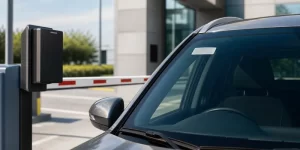
RFID windshield tags are a practical credential for parking lots, gated communities, logistics yards, office campuses, and vehicle access lanes where drivers should not need to stop, roll down a window, or hand over a card. The right tag is not chosen only by frequency or price. It depends on windshield glass, reader position, vehicle speed, lane width, encoding rules, and how the parking software identifies each vehicle.
For most parking access projects, buyers should define the lane environment first, then test samples on real vehicles before bulk production. A windshield tag that reads well in a clean test room may behave differently on coated glass, near metal frames, or in a busy entrance with several vehicles close together.
Quick Recommendation
Choose an RFID windshield tag when the project needs hands-free vehicle identification at a fixed access point. Before ordering, confirm the tag format, adhesive position, reader and antenna setup, encoding data, expected read zone, and removal policy. For mixed systems, compare windshield tags with RFID cards or other credentials instead of assuming one format fits every user.
| Project Question | What To Check | Why It Matters |
|---|---|---|
| What vehicles will use the lane? | Cars, vans, trucks, visitor vehicles, fleet vehicles, and windshield types | Glass coating, tag angle, and mounting height can change read consistency. |
| How fast will vehicles pass? | Stop-and-go gate, slow rolling entry, or controlled lane speed | Higher speed usually needs a better-defined read zone and lane discipline. |
| What data should be encoded? | UID-only use, EPC/serial encoding, site code, vehicle ID, or system-defined number | Wrong data format can create rework even if the physical tag reads correctly. |
| Is the tag transferable? | Tamper-evident adhesive, destructible structure, or standard adhesive | Parking operators often need to prevent a credential from being moved between vehicles. |
| Where will it be installed? | Inside windshield, edge position, reader side, driver visibility, and local rules | Placement affects both reading and driver acceptance. |
RFID windshield tags are adhesive RFID labels designed to be attached to vehicle glass, usually inside the windshield. They are commonly used as a vehicle credential for parking access, gated communities, office campuses, residential estates, logistics yards, and membership parking programs.
In many projects, these tags are part of a UHF RFID access system because UHF technology can support longer read zones than short-range HF/NFC cards. That does not mean the tag will always read at a fixed distance. Read performance depends on reader power, antenna type, antenna angle, windshield material, tag orientation, nearby vehicles, interference, and the access-control software workflow.
ASIARFID offers RFID windshield tags as part of its broader RFID tag range. If your project also needs labels for equipment, cartons, or documents, compare the windshield option with RFID tags, RFID stickers, and RFID inlays.
A typical parking access workflow is simple: the tag is encoded with a vehicle or account identifier, the reader antenna scans the lane, the access-control system checks the identifier, and the gate opens if the vehicle is authorized. The practical details are where projects succeed or fail.
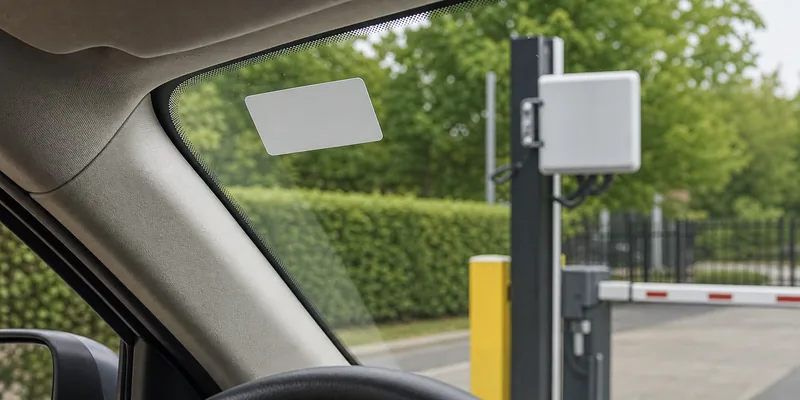
The reader should identify the intended vehicle without accidentally reading a nearby lane, tailgating vehicle, or parked car. This is why antenna angle, mounting height, shielding, and software rules matter. A longer theoretical read range is not always better; the goal is a controlled read zone that matches the gate behavior.
How To Choose the Right RFID Windshield Tag
1. Match the tag to the windshield environment
Windshield glass is not identical across vehicles. Some vehicles use coatings, heating wires, tinting, or curved glass that may affect RF performance. Ask for samples and test them on the real vehicle types in your project instead of approving the tag from a desktop scan only.
2. Decide whether the tag should be removable
For employee parking, fleet yards, and paid-access programs, operators often want a credential that is difficult to transfer. A tamper-evident or destructible structure can help, but the exact requirement should be confirmed before production. Visitor parking may need a different credential strategy, such as temporary cards or manually issued passes.
3. Confirm encoding before printing or shipping
Encoding errors are expensive because the tag may be physically correct but unusable in the software. Prepare the required number format, starting sequence, site code, EPC rule, or database import file before mass production. If your access-control vendor has a specific format, share it with the tag supplier early.
4. Test the complete lane, not only the tag
Reader power, antenna model, cable length, controller behavior, and gate timing all influence the final result. A good sample test should include several vehicles, multiple tag positions, intended vehicle speed, and the same reader position planned for the live entrance.
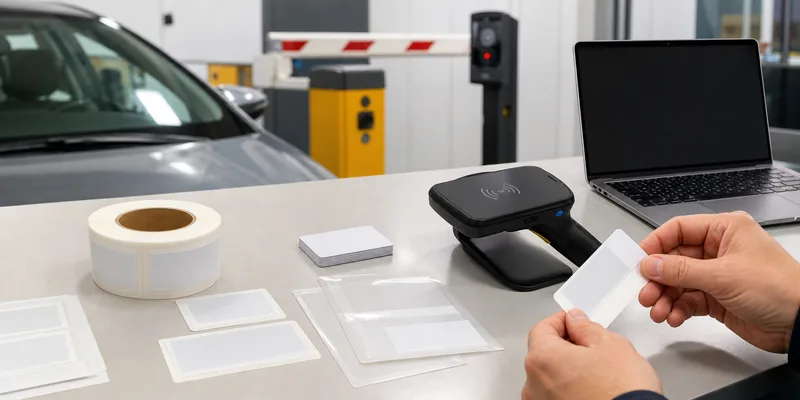
Common Applications
Residential communities: Windshield tags help residents enter without stopping for manual checks, while the management office can assign credentials by vehicle or household.
Office campuses: Companies can connect vehicle credentials with employee parking rights, visitor policies, and security checkpoints.
Logistics yards: Vehicle tags can support truck entry, dock scheduling, and yard movement when paired with the right gate software and lane design.
Paid parking and membership parking: A windshield credential can reduce ticket handling for monthly users, but payment, renewal, and blacklist rules should be planned in the software.
What To Prepare Before Ordering
- Application type: residential, commercial parking, campus, logistics yard, or fleet access.
- Vehicle types and windshield conditions to include in sample testing.
- Reader model, antenna position, lane width, gate type, and target vehicle behavior.
- Encoding format, serial-number rules, and any database import requirements.
- Artwork, logo use, visual numbering, or blank-tag preference.
- Whether the tag should be tamper-evident, destructible, or removable.
- Packaging, sorting, and matching rules if tags must be delivered in a specific sequence.
Why Work With ASIARFID
ASIARFID can help buyers compare windshield tags with related RFID credential formats, including cards, stickers, inlays, and other custom RFID tags. For parking and access-control projects, the useful conversation is specific: vehicle type, lane layout, reader setup, encoding data, printing needs, and sample testing plan.
If you are preparing a parking access project, send your application requirements and requested encoding format before ordering. Samples are the safest way to confirm tag placement and reader behavior before bulk production.
FAQ
No. A regular RFID sticker may work for many assets, but windshield applications need adhesive, placement, and RF behavior suitable for vehicle glass and access lanes. Use a windshield-specific sample when the tag will be read through glass at a gate.
Can one windshield tag work on every vehicle?
Not always. Windshield coating, mounting angle, vehicle height, and reader position can change performance. Test the tag on representative vehicle types before approving a bulk order.
What read distance should I expect?
Read distance depends on reader power, antenna design, tag orientation, windshield material, lane layout, and interference. Instead of relying on a single number, define the desired read zone and validate it with the actual reader setup.
They can help if the project uses tamper-evident or destructible structures and software rules tied to vehicle records. They should be treated as one part of the access policy, not as a complete security system by themselves.
Choose windshield tags when hands-free vehicle identification is the priority. Choose cards when users need a portable credential for doors, elevators, memberships, or temporary access. Some sites use both.
What information should I send for a quote?
Share the project application, quantity estimate, vehicle types, reader system, encoding format, artwork needs, adhesive/tamper requirements, and whether you need samples for lane testing.